Blog · Safety
Bladder Medication and Supplements: What to Ask Before You Mix
Bladder medication and supplements are not automatically safe together, and our cited sources do not list specific interactions for FemiCore's ingredients. Keep taking your prescription as directed and show your pharmacist the full label. Nothing in a supplement replaces a prescribed drug, and the label asks people with a medical condition to consult a physician first.
Written by the FemiCore label benchUpdated · 5 min read

The question
Can you take bladder medication and supplements together?
Sometimes, but only after someone checks. A supplement can change how a drug works, and a drug can change how a supplement behaves. The National Center for Complementary and Integrative Health asks people to tell every provider about everything they take (NCCIH, Using Supplements Wisely).
Our cited sources do not cover interactions for berberine, bearberry, Mimosa pudica or the probiotic strains. That gap means nothing is cleared, not that nothing exists. A pharmacist can search a full database that we cannot.
Cranberry is the one with a note: evidence on warfarin is conflicting (NCCIH, Cranberry).
Some products sold as supplements have also been found to contain undeclared prescription drugs (NCCIH, Using Supplements Wisely), another reason to show the bottle to a pharmacist.
Never stop or change a prescribed medicine because of a supplement. Talk to the prescriber first.
The drugs
What do bladder medicines do, and what is their catch?
Common prescribed bladder drugs calm the muscle that squeezes the bladder, and the best known are the antimuscarinics such as oxybutynin. The AUA/SUFU 2024 guideline offers behavioral therapy and bladder training to all patients first, and asks clinicians to discuss the dementia risk linked to antimuscarinics (AUA/SUFU 2024, OAB guideline).
A BMJ study of more than 40,000 people over 65 with dementia found they were up to 30% more likely to have been prescribed anticholinergics for bladder problems. Longer use was linked to higher risk, but the study shows an association with an unknown mechanism, and readers were told to keep taking the drug until they speak with their doctor (Harvard Health, anticholinergics and dementia).
Many women want to lower or stop a bladder drug, and that is a conversation for the prescriber, with a three-day diary in hand. NICE also advises caution with immediate-release oxybutynin in older women at higher risk of sudden deterioration (NICE NG123, incontinence in women).
The label
What should your pharmacist see on the FemiCore label?
They should see every line and the caution. FemiCore lists four herbal lines in a 350 mg blend and five strains in a 50 mg blend, with no single amounts and no cell count.
The ceilings below show the most each line could weigh.
Herbal Blend · 4 lines
- Mimosa pudicaMimosa pudica Seed Extract≤ 350 mg
- CranberryCranberry Extract (Vaccinium macrocarpon)(berry)(std. to 30% proanthocyanidin)≤ 175 mg
- BearberryBearberry (Arctostaphylos uva-ursi)(leaf)≤ 116.7 mg
- BerberineGranular Berberine Hydrochloride Extract 8% (bark/root)≤ 87.5 mg
Probiotic Blend · 5 lines
- L. crispatus LCr86strain 1 of 5≤ 50 mg
- L. acidophilus LA88strain 2 of 5≤ 25 mg
- L. plantarum N13strain 3 of 5≤ 16.7 mg
- L. gasseri LG08strain 4 of 5≤ 12.5 mg
- L. casei LC16strain 5 of 5≤ 10 mg
RuleA proprietary blend lists its lines from most to least by weight and prints only the total (21 CFR 101.36, supplement labeling).
SoLine 2 cannot outweigh line 1, so it holds at most half the blend; line 3 at most a third; line k at most total/k.
LimitsCeilings, not amounts: a lower line can be tiny. Probiotic weight is not a CFU count, and the label prints no CFU.
Each circle's area is drawn to scale with its ceiling. Our arithmetic from the label, not a lab test.
| Item | Why |
|---|---|
| The bottle or a photo of the label | Shows all nine ingredients and the caution |
| Your prescription list | Lets them look for conflicts |
| Your conditions, such as kidney disease | Some herbs are limited by them |
| Your three-day diary | Shows whether a change is needed |
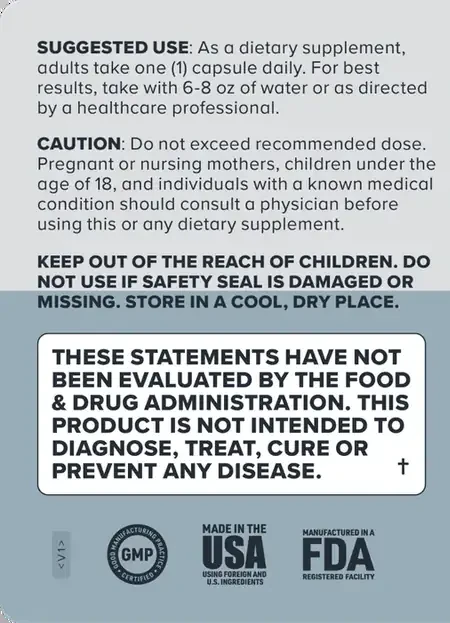
Bring the bottle, the sales page and your own medicine list, including over-the-counter products and vitamins. The label says to take one capsule daily with 6-8 oz of water or as directed by a healthcare professional. It also tells pregnant or nursing mothers, under-18s and anyone with a medical condition to consult a physician before use.

FemiCore: from $49 a bottle30 capsules · 2, 3 or 6 bottles · free shipping on 6 · 60-day money-back guarantee
See packsQuestions
Which questions should you ask before adding a supplement?
Ask five questions, and write the answers down.
Does it interact with my medicines?
Give the full ingredient list.
Does it fit my conditions?
Kidney disorders matter: the bearberry monograph says women with kidney disorders must not use it (EMA, Uvae ursi folium (bearberry leaf)).
Is the timing right?
Ask whether to space it from your dose.
What should I watch for?
Stomach upset, rash, trouble urinating or blood in urine are worth a call (FDA, Report a Supplement Problem).
When do we review?
Pick a date, such as day 60.
Decide
Should you choose a supplement or a prescription for leaks?
Do not frame it as a choice. First-line care for leaks is training and diary-keeping, with medicine added when needed (NICE NG123, incontinence in women).
Behavioral therapy and bladder training are offered to all patients first under the AUA/SUFU guideline (AUA/SUFU 2024, OAB guideline), and a supplement does not change that order. Use our supplements and medicines guide to prepare. If your pharmacist agrees, FemiCore is $79 a bottle on two, $69 on three and $49 on six, with a 60-day guarantee badge.
U.S. stocking partner for FemiCore
Ready to try FemiCore?
Start with a check of your medicines, then pick a pack. Six bottles ship free and cost the least per bottle, and every pack sits inside the 60-day money-back window.
- Secure checkout
- 60-day money-back guarantee
- Ships from the U.S.
FAQ
Medicine and supplement questions, answered
Can I take cranberry with warfarin?
The evidence is conflicting, so ask your prescriber before you do. They may want closer monitoring or a different plan.
Should I tell my doctor about supplements I take?
Yes, every one. List the name, the dose on the bottle and how long you have used it. Supplements are not tested like drugs before sale.
Can I stop my bladder pill to try a capsule?
No. Stopping a prescription on your own can bring symptoms back. Talk to the prescriber about any change.
Who wrote this
Written and reviewed by
Pages built from the label, the sales page and linked NIH, FDA, FTC, EMA and peer-reviewed sources.
Last updated . See our editorial standards and how we check reviews. This website is run by a U.S. stocking partner for FemiCore, not by the manufacturer or the label's distributor. We are paid when you buy through our order links.
Keep reading
More about FemiCore

U.S. stocking partner for FemiCore
Ready to try FemiCore?
Start with a check of your medicines, then pick a pack. Six bottles ship free and cost the least per bottle, and every pack sits inside the 60-day money-back window.
- Secure checkout
- 60-day money-back guarantee
- Ships from the U.S.