Guide
Bladder Supplements and Medications: The Safety Checks
Bladder supplements and medications can usually be discussed together, but the check comes before the first capsule, not after. FemiCore lists nine lines, and four raise questions: cranberry with warfarin, bearberry with kidney problems, berberine with unknown interactions, and live cultures with weak immunity. No study has tested the capsule alongside any medicine.
Written by the FemiCore label benchUpdated
The short version
Can you take bladder supplements with medications?
Often you can, but only after a doctor or pharmacist has seen both lists. A supplement is still a set of active plant compounds and cultures, and it meets your medicines in the same body.
FDA advises talking to a health professional before starting any supplement (FDA, Information for Consumers on Supplements). NCCIH adds that supplements can interact with medicines and that "natural" does not always mean safe (NCCIH, Using Supplements Wisely).
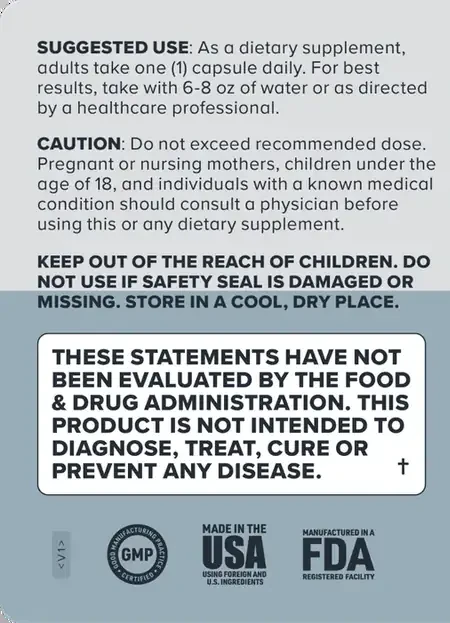
The FemiCore label says the same in its own words: "Do not exceed recommended dose. Pregnant or nursing mothers, children under the age of 18, and individuals with a known medical condition should consult a physician before using this or any dietary supplement."
Never stop, skip or change a prescribed dose because you started a supplement. If something feels wrong, call the prescriber first.
Line by line
Which FemiCore ingredients matter for medicine checks?
Four of FemiCore's nine lines carry a known medicine or health question: cranberry, bearberry, berberine and the five live cultures as a group. Mimosa pudica seed has no safety data at all in the sources we could open.
A blank in the research is a reason to ask, never proof of safety.
| Label line | What the sources say | Who should ask first |
|---|---|---|
| Cranberry extract (line 2) | Evidence on a warfarin interaction is conflicting (NCCIH, Cranberry) | Anyone on warfarin |
| Bearberry leaf (line 3) | One-week use in EU guidance; not for women with kidney disorders (EMA, Uvae ursi folium (bearberry leaf)) | Kidney disease, or anyone planning months of daily use |
| Berberine extract (line 4) | Interactions not covered by any source we could open; liver signal none (NIH LiverTox, Berberine) | Anyone on daily prescriptions |
| Mimosa pudica seed (line 1) | No public fact sheet found | Anyone pregnant, nursing or on daily medicine |
| Five Lactobacillus strains | Risk is higher with severe illness or weakened immunity (NCCIH, Probiotics) (NIH ODS, Probiotics) | Chemotherapy, transplant drugs, other immune-suppressing medicine |
Line ceilings and research for each ingredient sit on the FemiCore ingredients page.
Blood thinners
Does cranberry interact with warfarin?
The evidence is conflicting, so nobody can promise it does or it does not. NCCIH says to talk to your health care provider before taking cranberry if you take warfarin (NCCIH, Cranberry).
FemiCore's cranberry is at most 175 mg of extract by label order; the true amount is not printed.
Infections
Can you take a probiotic supplement while on antibiotics?
Usually the question is timing and safety, and your pharmacist should answer it for your exact antibiotic. None of our cited sources says how far apart to space a probiotic from an antibiotic dose.
What the sources do say is firmer. CDC notes that antibiotics can disrupt the body's own microbes and should be used only when needed (CDC, About UTIs).
A supplement never stands in for an antibiotic. Cranberry does not treat an infection that has already started (NCCIH, Cranberry), and NICE calls lactobacillus evidence for repeat UTIs inconclusive (NICE NG112, recurrent UTI). Finish the course as prescribed.
Bladder medicines
What about prescription bladder medicines such as oxybutynin?
No study has tested FemiCore alongside oxybutynin, tolterodine, solifenacin or any other bladder medicine. Tell the prescriber about the supplement so it sits on the same record.
These three are anticholinergics, a group Mayo Clinic lists among medical options for leaks (Mayo Clinic, incontinence treatment). A large BMJ study linked longer use of such drugs with a higher dementia risk in people over 65. It was an association, and people were told to keep taking them until they speak with a doctor (Harvard Health, anticholinergics and dementia).
NICE notes that a bladder drug may take at least 4 weeks to show benefit (NICE NG123, incontinence in women), so give it a fair trial.
Start a supplement and a prescription in the same month, and a bladder diary cannot tell you which one changed things. Where your doctor agrees, start one at a time.

FemiCore: from $49 a bottle30 capsules · 2, 3 or 6 bottles · free shipping on 6 · 60-day money-back guarantee
See packsAfter menopause
Can you use vaginal estrogen and a bladder supplement together?
No source we could open looks at that combination, so the decision belongs with the doctor who prescribes the estrogen. Bring the FemiCore bottle to that visit.
Vaginal estrogen comes up for two bladder reasons. NICE says it may be considered for women with repeat UTIs after menopause when simpler measures fail (NICE NG112, recurrent UTI). Mayo Clinic lists low-dose topical vaginal estrogen among medical options for leaks (Mayo Clinic, incontinence treatment).
Lower estrogen after menopause can thin the tissue of the urinary tract and bladder area, part of the genitourinary syndrome of menopause (Cleveland Clinic, postmenopause). More on that in the menopause and bladder guide.
Procedures
Should you stop supplements before surgery?
Tell your surgical team about every supplement well before the day, and follow their instructions on when to pause. NCCIH notes that some supplements raise bleeding risk or affect anesthesia (NCCIH, Using Supplements Wisely).
Our sources give no fixed number of days for FemiCore or its lines; that is the surgical team's call.
- Write "FemiCore, one capsule a day" on the pre-op form, with the start date.
- Mention cranberry, bearberry and berberine by name, since the form may not ask.
Self-check
Is FemiCore a fit with your current medicines?
Six yes-or-no questions sort out who needs a talk first and who should not start at all. A single yes is enough to pause.
The result is a checklist for the conversation, not a clearance.
At the counter
What should you ask a pharmacist about bladder supplements?
Ask whether any of the nine label lines clash with your medicines, your kidneys or your immune system. Pharmacists check interactions every day, and the advice is usually free.
Bring the bottle
The Supplement Facts panel names all nine lines. A photo of it works too.
Bring a full list
Include prescriptions, over-the-counter pills, eye drops, creams and other supplements.
Ask three questions
Does anything here interact with my medicines? Is bearberry right for daily use with my kidneys? Should I space it from any dose?
If a reaction seems serious, stop the supplement and report it to FDA's Safety Reporting Portal (FDA, Report a Supplement Problem). Day-to-day effects are covered on the FemiCore side effects page, and the who it's for page covers age, pregnancy and other groups.
FAQ
Medicine questions
Can I take FemiCore if I am on warfarin?
Only after your prescriber or pharmacist agrees. FemiCore lists cranberry extract, and NCCIH calls the evidence on cranberry and warfarin conflicting (NCCIH, Cranberry). Your doctor may want an extra blood test after you start. Do not change your warfarin dose yourself.
Should I take a probiotic during a course of antibiotics?
Ask the pharmacist who filled the antibiotic. Our sources give no spacing rule. What matters most is finishing the antibiotic as prescribed, since a supplement cannot replace it, and telling the pharmacist about any live-culture product you take.
Is it safe to combine FemiCore with oxybutynin?
No study has tested that pairing, so nobody can call it safe or unsafe. Tell the prescriber you take FemiCore. Oxybutynin is an anticholinergic, and the AUA/SUFU guideline asks clinicians to discuss dementia risk with long-term users (AUA/SUFU 2024, OAB guideline).
Does a bladder supplement change how vaginal estrogen works?
No source we found addresses that question. Vaginal estrogen is a prescription treatment that NICE says may be considered for repeat UTIs after menopause (NICE NG112, recurrent UTI). Show the supplement to the prescriber and let them decide whether to add it.
How long before surgery should I pause FemiCore?
Our sources give no set number of days. NCCIH advises telling your providers about supplements well before surgery, because some affect bleeding or anesthesia (NCCIH, Using Supplements Wisely). Follow your surgical team's timing, and ask when to restart.
What should I bring to a pharmacist to check FemiCore?
The bottle or a clear photo of its Supplement Facts panel, plus a full list of every medicine, cream, drop and supplement you use. Ask about interactions, kidney safety for the bearberry line, and timing with any dose.
Who wrote this
Written and reviewed by
Pages built from the label, the sales page and linked NIH, FDA, FTC, EMA and peer-reviewed sources.
Last updated . See our editorial standards and how we check reviews. This website is run by a U.S. stocking partner for FemiCore, not by the manufacturer or the label's distributor. We are paid when you buy through our order links.
Keep reading
More about FemiCore


U.S. stocking partner for FemiCore
Ready to try FemiCore?
Start with a check of your medicines, then pick a pack. Six bottles ship free and cost the least per bottle, and every pack sits inside the 60-day money-back window.
- Secure checkout
- 60-day money-back guarantee
- Ships from the U.S.