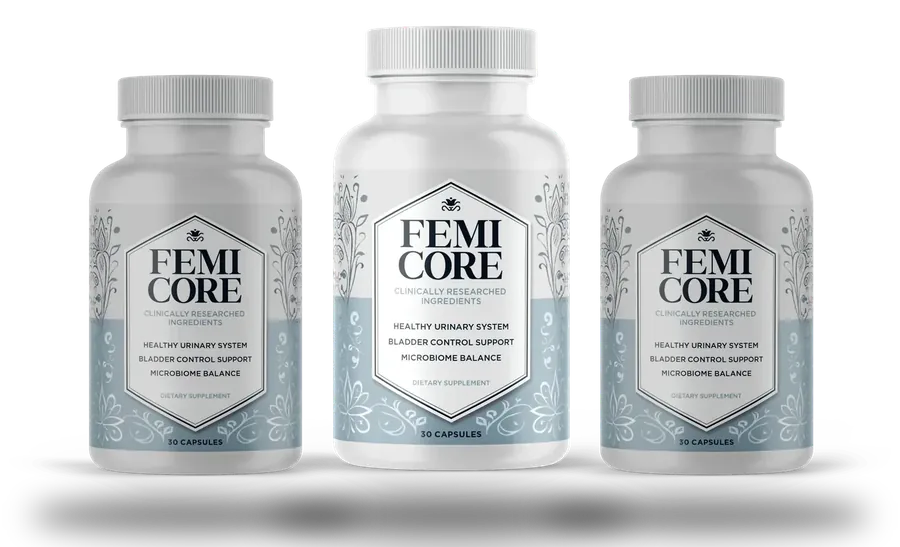
Ingredient
Mimosa Pudica Seed Extract: Line 1 of FemiCore's Herbal Blend
Mimosa pudica seed extract is the first of four lines in FemiCore's 350 mg herbal blend, made from seeds of the "sensitive plant". Label order puts it somewhere between 87.5 mg and 350 mg per capsule; the real amount is not printed. We found no human trial, no bladder study and no public health fact sheet for it, so its safety record is thin.
Written by the FemiCore label benchUpdated
The plant
What is Mimosa pudica seed extract?
Mimosa pudica seed extract is a concentrate made from the seeds of a low, creeping plant in the pea family. Its common name, the sensitive plant, comes from the way its small leaflets fold shut when touched.
FemiCore prints it as "Mimosa pudica Seed Extract" and nothing more. There is no extract ratio, no solvent and no marker compound. Compare the cranberry line just below it, which at least states 30% proanthocyanidin.
What the name on the label does and does not tell you
- The plant part: the seed, not the leaf or root.
- The form: an extract, so concentrated in some way.
- Not printed: how strong it is, or how it was made.
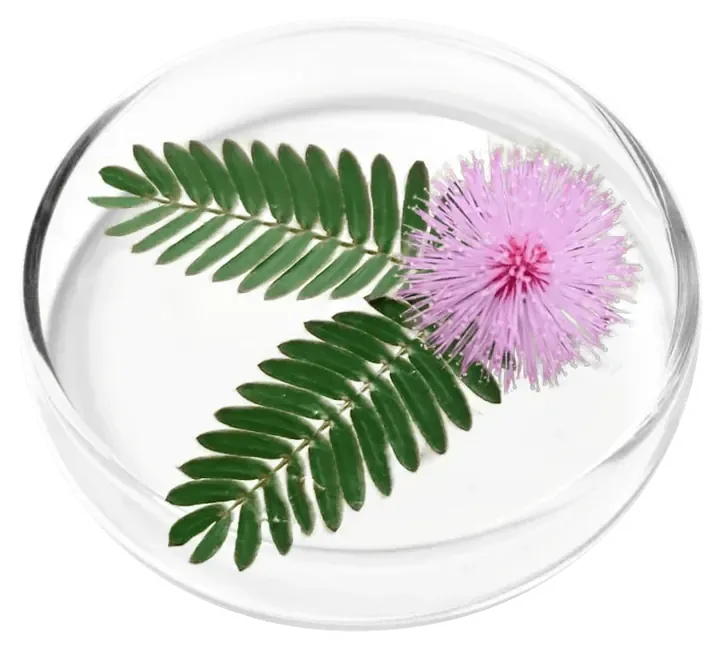
Profile
What does the FemiCore label say about Mimosa pudica?
The FemiCore label lists Mimosa pudica seed extract as line 1 of 4 in the Herbal Blend, with no amount of its own. The profile sets each printed fact beside what research we found.
Two rows are empty in a way that matters: the dose used in research and the strength of evidence. For this line, neither has a public source.
| Name on the label | Mimosa pudica Seed Extract |
|---|---|
| What it is | Seeds of the 'sensitive plant', a creeping legume |
| Place on the label | Line 1 of 4 in the 350 mg herbal blend |
| Amount per capsule | Not printed; line 1 of 4 in the 350 mg herbal blend. Label order caps it at 350 mg |
| Amount used in research | No human dose found in public health sources |
| Strength of evidence | No human trial found; no bladder trial |
| Marketed or traditional use | Traditional remedy; often sold for gut 'cleanses' |
| Main caution | No public health fact sheet covers it. The label asks pregnant or nursing women to consult a physician first. |
Label order
Why is Mimosa pudica listed first, and how much is in a capsule?
Mimosa pudica is listed first because it is the heaviest of the four herbal lines. Blend lines must run from most to least by weight (21 CFR 101.36, supplement labeling).
That rule gives a ceiling and, for line 1 only, a floor. The ceiling is the whole blend, 350 mg, if the other three were close to nothing. The floor comes from simple sharing: four lines add up to 350 mg, so the heaviest must hold at least a quarter, 87.5 mg.
| Blend | Herbal Blend, 350 mg, four lines |
|---|---|
| Place | Line 1 of 4: the heaviest |
| Most it can be | 350 mg (the whole blend) |
| Least it can be | 87.5 mg (350 divided by 4) |
| Amount printed | Not printed |
One more thing follows. Cranberry, line 2, can never outweigh Mimosa pudica. So the line with the least public research takes the largest share of the blend.
Marketing claims
Is there proof behind Mimosa pudica parasite cleanse claims?
No. We found no human trial and no public health source that supports Mimosa pudica seed as a parasite or gut cleanse. Those claims come from online sellers, not from FemiCore's label.
Seed products are often sold that way, with talk of the seeds swelling into a gel that sweeps the gut. That story is marketing until a controlled human study shows it. The FTC expects health claims to rest on that kind of evidence (FTC, Health Products Compliance Guidance).
See a clinician for a stool test. Symptoms like belly pain or diarrhea have many causes, and a real infection needs the right medicine, not a seed powder.
Bladder evidence
Does Mimosa pudica seed help the bladder?
No study we could find tested Mimosa pudica seed for the bladder, urinary tract or leaks. The label does not say why it was chosen.
That leaves a gap in FemiCore's design. The best-supported herbal line is cranberry, and it sits second. The cranberry extract profile has its trial record.
For leaks, the tested steps are training, not herbs. See the pelvic floor training guide.

FemiCore: from $49 a bottle30 capsules · 2, 3 or 6 bottles · free shipping on 6 · 60-day money-back guarantee
See packsSafety
Is Mimosa pudica seed extract safe?
Its safety is not established, because no public fact sheet or monograph covers the seed. Unknown is not the same as harmful, but it is not reassuring either.
NCCIH reminds readers that "natural" does not always mean safe, that supplements can interact with medicines, and that you should tell your care team about them well before surgery (NCCIH, Using Supplements Wisely).
Stop the capsule if you get hives, throat swelling or severe stomach symptoms, and report it to FDA (FDA, Report a Supplement Problem). Keep taking prescribed medicine, and ask a pharmacist before adding any supplement to it.
More on FemiCore side effects.
Pregnancy
Can you take Mimosa pudica seed while pregnant or nursing?
Ask your obstetric clinician first, and expect a cautious answer. We found no data on Mimosa pudica seed in pregnancy or breastfeeding.
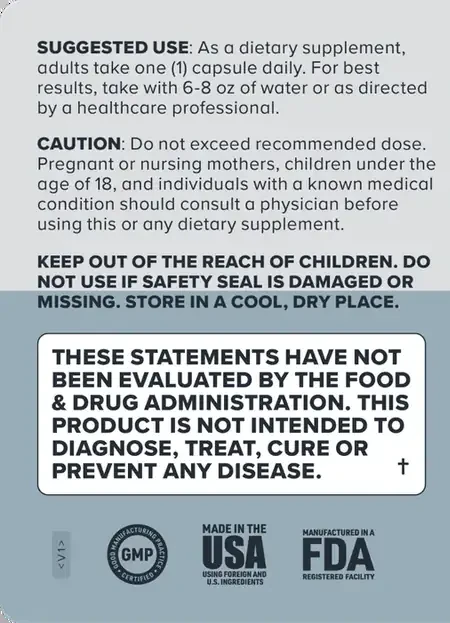
FemiCore's own caution asks pregnant or nursing mothers to consult a physician before use. NCCIH adds that many supplements were never tested in pregnant or nursing women (NCCIH, Using Supplements Wisely).
Next line
Where does Mimosa pudica sit among FemiCore's nine ingredients?
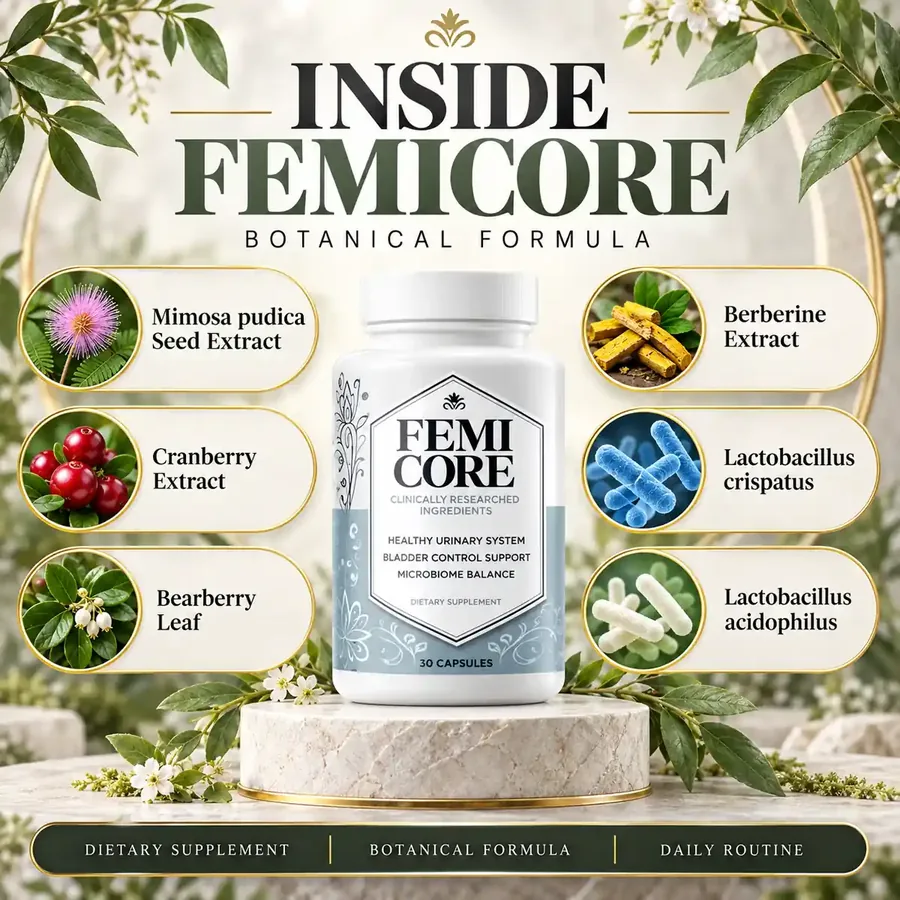
Mimosa pudica seed is the first of nine lines and the first of four herbs. After it come cranberry, bearberry leaf and berberine, then five probiotic strains in a separate 50 mg blend.
See every line side by side on the FemiCore ingredients page.
- 21 CFR 101.36 - Nutrition labeling of dietary supplements. Electronic Code of Federal Regulations (eCFR), 2026.Under paragraph (c), a proprietary blend is labeled 'Proprietary Blend' or similar and its quantity is the total weight of its dietary ingredients. The ingredients inside are listed by weight in descending order of predominance, indented under the blend name, without a separate amount for each ingredient.
- Using Dietary Supplements Wisely. National Center for Complementary and Integrative Health (NIH), 2019.'Natural' does not always mean safe. Supplements can interact with medicines, some raise bleeding risk or affect anesthesia (tell providers well before surgery), and many have not been tested in pregnant or nursing women or children. Some products sold as supplements contain undeclared prescription drugs; stop a supplement and call a provider if side effects occur, and report concerns through the HHS Safety Reporting Portal.
- Health Products Compliance Guidance. Federal Trade Commission, 2022.Published December 20, 2022. Health-benefit claims generally need competent and reliable scientific evidence, meaning randomized, controlled human clinical testing; animal and in vitro studies alone are insufficient and observational studies do not prove causation. Testimonials need the same substantiation as the claim, consumer experiences alone are never sufficient, and a 'Results not typical' disclaimer does not cure a deceptive testimonial.
- How to Report a Problem with Dietary Supplements. U.S. Food and Drug Administration, 2025.If a supplement may have caused a serious reaction, stop using it immediately and report through the Safety Reporting Portal (safetyreporting.hhs.gov); partial information still helps. Serious reactions FDA lists include hives or throat swelling, fainting, severe GI symptoms, trouble urinating or dark urine, blood in urine, yellowing of the skin or eyes, and mood or behavior changes. Content current as of March 13, 2025.
FAQ
Questions about Mimosa pudica seed
What is Mimosa pudica, the sensitive plant?
Mimosa pudica is a creeping plant in the pea family, known as the sensitive plant because its leaflets fold when touched. FemiCore uses an extract of its seed, not its leaves, and prints no strength or extraction method for it.
Does Mimosa pudica seed work as a parasite cleanse?
No evidence shows it. We found no human trial or public health source backing parasite or gut cleanse claims for the seed. If you have symptoms you think are a parasite, a clinician can order a stool test and the right treatment.
How much Mimosa pudica seed is in FemiCore?
The label does not say. As line 1 of a 350 mg blend of four, it holds at least 87.5 mg and at most 350 mg per capsule. Those bounds come from label order, not from a lab test or the maker.
Is Mimosa pudica seed safe to take every day?
Nobody can say, because no fact sheet or monograph covers daily use of the seed. Stop and call a clinician if you get a rash, swelling or bad stomach upset, and ask a pharmacist first if you take daily medicines.
Can I take Mimosa pudica seed when pregnant?
Only with your obstetric clinician's approval. We found no pregnancy or breastfeeding data for it, and FemiCore's label caution tells pregnant and nursing mothers to consult a physician before using the product.
Why is Mimosa pudica the first ingredient in FemiCore?
Because it weighs the most of the four herbs. Proprietary blends list lines from heaviest to lightest (21 CFR 101.36, supplement labeling), so Mimosa pudica outweighs cranberry, bearberry and berberine in every capsule, even though it has the least public research of the four.
Who wrote this
Written and reviewed by
Pages built from the label, the sales page and linked NIH, FDA, FTC, EMA and peer-reviewed sources.
Last updated . See our editorial standards and how we check reviews. This website is run by a U.S. stocking partner for FemiCore, not by the manufacturer or the label's distributor. We are paid when you buy through our order links.
Keep reading
More about FemiCore
U.S. stocking partner for FemiCore
Ready to try FemiCore?
Start with a check of your medicines, then pick a pack. Six bottles ship free and cost the least per bottle, and every pack sits inside the 60-day money-back window.
- Secure checkout
- 60-day money-back guarantee
- Ships from the U.S.