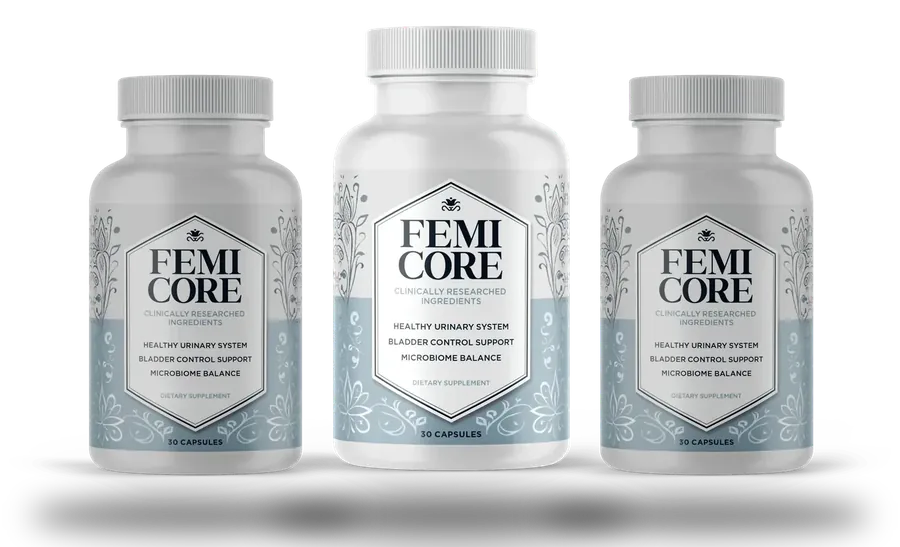
How it works
How Does FemiCore Work? The Two Blends, Step by Step
FemiCore is built on two parts, a herbal blend and a probiotic blend, taken together in one daily capsule.
The 350 mg herbal blend is led by Mimosa pudica seed and cranberry. The 50 mg blend holds five Lactobacillus strains. Of the nine lines, cranberry has the most research.
See every line in order on the FemiCore ingredients page.
Written by the FemiCore label benchUpdated
The sales story
How does FemiCore work, according to its sellers?
FemiCore works, in the sellers' telling, by fixing an imbalance of microbes. The sales page says the formula is "designed to support bladder health by targeting the microbiome imbalance" (FemiCore sales page). It names no study that tested that idea in people taking the capsule.
That is a claim to check, not a finding. So we read the label like a specimen card: what is printed, what is missing, and what each line was studied for.
What the four sales steps say
The vendor's graphic shows a bottle ringed by ingredient icons and four numbered steps. None of them is backed by a published FemiCore result.
The graphic also shows six ingredients. The label lists nine, because each of the five strains counts as its own line. The FemiCore supplement facts panel is the record we trust.

The formula
What is the FemiCore formula made of?
The FemiCore formula is nine named lines split into two blends. Four plant lines share 350 mg. Five bacterial strains share 50 mg. Together that is 400 mg of listed ingredients in one gelatin capsule.
Think of the capsule as a small culture dish with two zones. The herbal zone is seven times heavier than the probiotic zone, so most of what you swallow by weight is plant material.
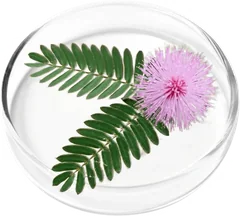 Herbal 1/4Mimosa pudica≤ 350 mg
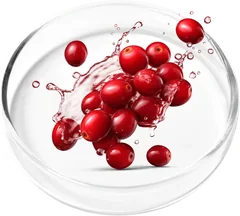 Herbal 2/4Cranberry≤ 175 mg
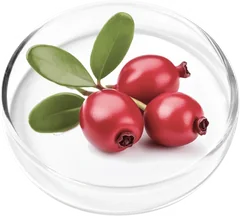 Herbal 3/4Bearberry≤ 116.7 mg
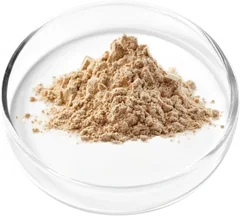 Herbal 4/4Berberine≤ 87.5 mg
 Strain 1/5L. crispatus LCr86≤ 50 mg
 Strain 2/5L. acidophilus LA88≤ 25 mg
 Strain 3/5L. plantarum N13≤ 16.7 mg
 Strain 4/5L. gasseri LG08≤ 12.5 mg
 Strain 5/5L. casei LC16≤ 10 mg
Vendor petri-dish illustrations from the sales page, one per label line; not photos of the capsule contents. Weights are label-order ceilings.
Two blends
Why does FemiCore use two separate blends?
FemiCore uses two blends because the label sorts its lines into two kinds: dried plant extracts and live-culture bacteria. Each kind gets its own proprietary blend, with one total weight and no single amounts.
The rule for a blend is simple. Lines appear from heaviest to lightest, and only the total is printed (21 CFR 101.36, supplement labeling). That order lets us set a ceiling for each line, and nothing more precise than that.
Worked example: berberine is line 4 of 4 in 350 mg, so it weighs at most a quarter, 87.5 mg. The real figure may be far lower.
Herbal Blend · 4 lines
- Mimosa pudicaMimosa pudica Seed Extract≤ 350 mg
- CranberryCranberry Extract (Vaccinium macrocarpon)(berry)(std. to 30% proanthocyanidin)≤ 175 mg
- BearberryBearberry (Arctostaphylos uva-ursi)(leaf)≤ 116.7 mg
- BerberineGranular Berberine Hydrochloride Extract 8% (bark/root)≤ 87.5 mg
Probiotic Blend · 5 lines
- L. crispatus LCr86strain 1 of 5≤ 50 mg
- L. acidophilus LA88strain 2 of 5≤ 25 mg
- L. plantarum N13strain 3 of 5≤ 16.7 mg
- L. gasseri LG08strain 4 of 5≤ 12.5 mg
- L. casei LC16strain 5 of 5≤ 10 mg
RuleA proprietary blend lists its lines from most to least by weight and prints only the total (21 CFR 101.36, supplement labeling).
SoLine 2 cannot outweigh line 1, so it holds at most half the blend; line 3 at most a third; line k at most total/k.
LimitsCeilings, not amounts: a lower line can be tiny. Probiotic weight is not a CFU count, and the label prints no CFU.
Each circle's area is drawn to scale with its ceiling. Our arithmetic from the label, not a lab test.
Weight is not the same as live cells. NIH points out that a probiotic's printed weight includes dead cells and advises a CFU count stated for the end of shelf life (NIH ODS, Probiotics). FemiCore prints no CFU count.
Line by line
What is each FemiCore ingredient supposed to do?
Each FemiCore ingredient is there for a reason the sellers imply, but only cranberry has human trials tied to the urinary tract. The table lists every line, its ceiling, and the nearest evidence we could find.
| Line | Most per capsule | What it is studied for | Bladder or leak evidence |
|---|---|---|---|
| Mimosa pudica seed extract | 350 mg | Traditional use; sold for gut "cleanses" | No human trial or fact sheet found |
| Cranberry extract, 30% PAC | 175 mg | Repeat urinary infections (Cochrane 2023, cranberries and UTI) | Fewer repeat UTIs in some groups; no leak data |
| Bearberry leaf | about 117 mg | Short courses for mild urinary symptoms (EMA, Uvae ursi folium (bearberry leaf)) | Traditional use only; one week at most |
| Berberine HCl extract 8% | 87.5 mg | Mostly metabolic uses (NIH LiverTox, Berberine) | None found |
| L. crispatus LCr86 | 50 mg | Vaginal flora score (ClinicalTrials.gov NCT06830122, LCr86) | None; trial results not posted |
| L. acidophilus LA88 | 25 mg | General probiotic use | No strain trial found |
| L. plantarum N13 | about 17 mg | General probiotic use | No strain trial found |
| L. gasseri LG08 | 12.5 mg | General probiotic use | No strain trial found |
| L. casei LC16 | 10 mg | General probiotic use | No strain trial found |
Full profiles, with sources, sit on the FemiCore ingredients page.
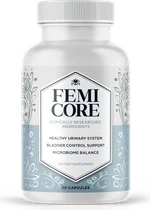
FemiCore: from $49 a bottle30 capsules · 2, 3 or 6 bottles · free shipping on 6 · 60-day money-back guarantee
See packsThe microbiome claim
Does FemiCore really support microbiome balance?
No one has measured whether FemiCore supports "Microbiome Balance", the third claim on its front panel. The phrase is a structure/function claim, and the dagger after it points to the FDA statement that it was not evaluated (21 CFR 101.93, structure/function claims).
Probiotic effects belong to individual strains, not to a species or a genus (NCCIH, Probiotics). So the useful question is what each strain code has shown. For four of the five codes, we found no published trial.
The fifth, LCr86, has one completed industry trial: 80 women, 10 billion CFU a day by mouth, eight weeks, scored on vaginal flora. No results are posted (ClinicalTrials.gov NCT06830122, LCr86).
A single L. crispatus strain placed in the vagina lowered bacterial vaginosis returns, about 30% versus 45% on placebo (Cohen et al. 2020, Lactin-V trial). That product went in vaginally, not by mouth, and it was not measuring the bladder. It shows the species is worth studying, not that this capsule works.
The basics of vaginal and urinary microbes are in our urinary microbiome guide.
Timing
How long does FemiCore take to work?
There is no tested answer, because no trial has followed women taking FemiCore. Any week count you see in an ad is a guess.
What we can give is a fair test window. Bladder training usually needs six to eight weeks to show results (Cleveland Clinic, overactive bladder), and pelvic floor training runs at least three months (NICE NG123, incontinence in women).
Your own test
How can you tell if FemiCore is doing anything for you?
You can tell only by comparing records, not memories. Keep a three-day bladder diary before the first capsule and repeat it around day 30 and day 45. Count trips, urges and leaks the same way each time.
Change one thing at a time, or you will not know what helped. Keep taking prescribed medicine as directed; a supplement is never a reason to change it.
The four steps below set out a simple routine. Dose details are on how to take FemiCore, and an honest look at each claim is on FemiCore benefits.
Check the seal
If the safety seal is damaged or missing, the label says not to use the bottle. Check it before the first capsule, and store the bottle somewhere cool and dry.
One capsule, 6-8 oz of water
One capsule is the whole daily serving. The label asks for 6-8 oz of water with it, about one glass. Never double up after a missed day.
Write down your bladder days
A three-day bladder diary before you start, and again later, shows changes better than memory does. The diary on this site prints one.
Decide before day 60
The money-back window runs 60 days from purchase. Look at your diary around day 45 and decide while there is time to call.
FAQ
How FemiCore works: your questions
What does the sales page say FemiCore does in the body?
It says the formula is "designed to support bladder health by targeting the microbiome imbalance". That is a mechanism the sellers describe, not one they show. No study of the capsule is named, so the claim stands untested, and the only line with solid human data, cranberry, was studied for repeat infections rather than leaks.
What does "Microbiome Balance" mean on the FemiCore label?
It is a structure/function phrase with a dagger pointing to the FDA statement, so it was never evaluated. It refers to the five Lactobacillus strains in the 50 mg blend. No CFU count is printed, and no published trial links these strain codes to bladder health, so the phrase describes an aim, not a measured result.
How soon might someone notice a change on FemiCore?
Nobody knows, because no trial of the capsule reports any timeline. For context, bladder training often takes six to eight weeks to show results, and pelvic floor programs run at least three months. Compare a three-day diary before you start with one around day 45 instead of trusting a week count from an ad.
Does FemiCore contain caffeine or any other stimulant?
No. The label lists no caffeine, guarana, green tea or other stimulant among its nine active lines or its five other ingredients. That is useful, since caffeine can make bladder urges worse. Coffee, tea and cola in your day still count, and cutting back on them is a first step clinicians suggest for urgency.
Which FemiCore ingredient has the most research behind it?
Cranberry extract. A 2023 Cochrane review of 50 trials found fewer symptomatic, culture-confirmed UTIs with cranberry products, including in women with repeat infections. Those trials used other products and doses, and none measured leaks. In FemiCore, cranberry is line 2 of 4, so it weighs at most 175 mg.
Why are the herbs and the probiotics in separate blends?
Because the label groups them by kind: four dried plant lines in a 350 mg herbal blend and five bacterial strains in a 50 mg probiotic blend. Each blend prints only its total and lists lines from heaviest to lightest, which is why we can give a ceiling for every line but never an exact amount.
Who wrote this
Written and reviewed by
Pages built from the label, the sales page and linked NIH, FDA, FTC, EMA and peer-reviewed sources.
Last updated . See our editorial standards and how we check reviews. This website is run by a U.S. stocking partner for FemiCore, not by the manufacturer or the label's distributor. We are paid when you buy through our order links.
Keep reading
More about FemiCore



U.S. stocking partner for FemiCore
Ready to try FemiCore?
Start with a check of your medicines, then pick a pack. Six bottles ship free and cost the least per bottle, and every pack sits inside the 60-day money-back window.
- Secure checkout
- 60-day money-back guarantee
- Ships from the U.S.