FAQ
FemiCore FAQ: Quick Answers to Common Questions
The FemiCore FAQ gives 42 short answers to the questions buyers ask most.
They sit in seven groups: the basics, the label, daily use, safety, results, prices and after-sales help. Each one starts from the printed label of the 30-capsule bottle.
For the full dose guide, see how to take FemiCore.
Written by the FemiCore label benchUpdated
Search
What does the FemiCore FAQ cover?
No question matches. Try another word.
The FemiCore FAQ covers the questions people ask after the main pages: small label details, daily habits, odd safety cases, packs and parcels. Type a word in the search box, or scroll the seven groups below.
Each answer is short on purpose. When a topic needs more room, the answer links to the page that covers it in full.
| Group | What it answers | Longer read |
|---|---|---|
| 1. The basics | What the product is and is not | FemiCore home |
| 2. Label details | Gelatin, sugar, vitamins, extra ingredients | Supplement facts |
| 3. Day to day | Coffee, other supplements, fluids | How to take it |
| 4. Safety cases | Immunity, bladder pain, birth control | Side effects |
| 5. Results | Night trips, childbirth, BV, stopping | What to expect |
| 6. Prices and packs | Year supply, "2+1", ebooks, tax | Pricing |
| 7. After the order | Damage, changes, returns, reports | Contact desks |
Group 1
What is FemiCore, in plain terms?
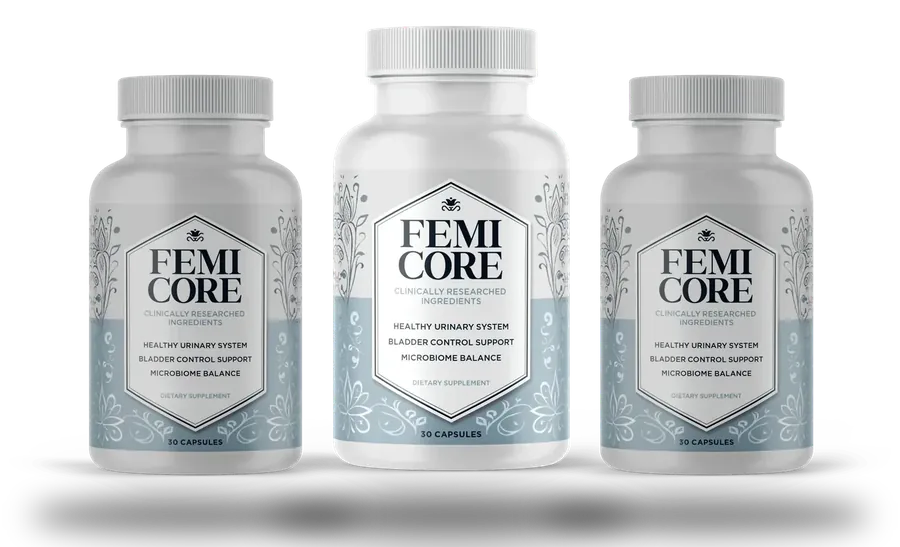
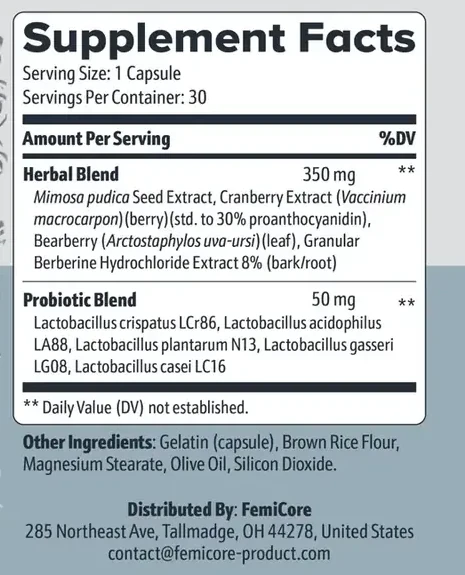
FemiCore is a once-a-day dietary supplement capsule sold to women for bladder and urinary support. It holds a 350 mg herbal blend and a 50 mg probiotic blend.
It is not a medicine, and nobody has tested the capsule in a trial. The answers below sort out what the front of the bottle means and what it does not.
What is FemiCore used for?
People buy FemiCore hoping to support bladder comfort and control, based on the three label claims: "Healthy Urinary System", "Bladder Control Support" and "Microbiome Balance". Those are marketing claims the FDA has not evaluated. No trial has tested the capsule for any of them.
Is FemiCore a medicine or a supplement?
FemiCore is a dietary supplement, not a medicine. Supplements reach shelves without FDA approval of safety or effect (FDA, Information for Consumers on Supplements), and they may not claim to treat a disease. A prescription bladder drug, by contrast, had to pass trials before sale.
Is the FemiCore on this site the same product as on the sales page?
Yes. Our order buttons send you to the FemiCore checkout linked from the sales page, and the bottle facts here come from its printed label. If the sales page and the label ever disagree, this site follows the label.
What does "Clinically Researched Ingredients" on the bottle mean?
It means some of the ingredients have been studied somewhere, not that FemiCore was. Cranberry has dozens of trials for repeat urinary infections (Cochrane 2023, cranberries and UTI), while the Mimosa pudica seed line has no human trial we could find. The phrase says nothing about doses or results.
Is there a published FemiCore study I can read?
No. We found no published trial of the FemiCore capsule. The sales page calls it "scientifically proven" without naming a study. The nearest is a completed trial of one strain, LCr86, for a vaginal outcome, with no results posted (ClinicalTrials.gov NCT06830122, LCr86).
Does FemiCore contain hormones or estrogen?
No hormone is listed on the label. The capsule holds four plant lines, five bacterial strains and five other ingredients. If you are thinking about estrogen for menopause bladder symptoms, that is a prescription question for your clinician, not something this capsule supplies.
Group 2
What else is, and is not, on the FemiCore label?
The FemiCore label lists nine active lines and five other ingredients, and nothing more. Anything not printed, such as sugar, vitamins or D-mannose, is not declared in the capsule.
Some useful facts are missing too, like the animal source of the gelatin. Where the label is silent, the answers say so.
Is the gelatin in FemiCore from beef or pork?
The label does not say. It lists "Gelatin (capsule)" with no source animal, so anyone avoiding beef or pork for religious or dietary reasons cannot confirm it from the bottle. Ask the brand through the email printed on the label before buying.
Does FemiCore contain sugar or sweeteners?
No sugar or sweetener is listed. The other ingredients are gelatin, brown rice flour, magnesium stearate, olive oil and silicon dioxide. A capsule is swallowed whole, so it does not need flavoring the way a gummy or a drink mix would.
Does FemiCore contain D-mannose?
No. D-mannose is a sugar often sold for urinary support, but it is not among the nine lines on the FemiCore label. If you already take a D-mannose product, show both labels to a pharmacist before adding FemiCore.
Does FemiCore contain any vitamins or minerals?
No vitamins are listed, and no mineral is listed as an active ingredient. Magnesium stearate appears only as a flow aid in the capsule. That makes stacking with a daily multivitamin less of a worry, though a pharmacist should still check.
Does FemiCore contain gluten?
No gluten grain is listed; brown rice flour is the only grain, and rice is naturally gluten free. A sales-page badge says gluten free, but no gluten test or certifier is named. People with celiac disease may want written confirmation from the brand.
Which of the four herbal lines has the strongest published evidence?
Cranberry extract. A 2023 Cochrane review pooled 50 trials with 8,857 people on cranberry and urinary infections (Cochrane 2023, cranberries and UTI). Bearberry has traditional-use guidance only, berberine has no bladder trial, and the strains have one registered trial between them.
Group 3
How does FemiCore fit into a normal day?
FemiCore fits into a day as one capsule with a glass of water, at any time you choose. The label sets no food rule and no time of day.
The rest of the day matters more for your bladder than the capsule does: what you drink, when you go, and whether you train your pelvic floor.
Write down three days of drinks, toilet trips and leaks before you change anything. That record answers many of the questions below better than a general rule can (NICE NG123, incontinence in women).
Can I open a FemiCore capsule and mix it into food?
The label does not say you can. It describes swallowing one capsule with 6-8 oz of water. If you have trouble swallowing capsules, ask a pharmacist before opening one, since the label gives no guidance on it.
Can I take FemiCore with coffee?
The label sets no rule against it. Coffee may matter for your bladder, though: NICE suggests a trial of less caffeine for people with overactive bladder (NICE NG123, incontinence in women). Taking the capsule with plain water, as the label asks, sidesteps the question.
Can I take FemiCore with another probiotic?
No label rule covers it. Two products would add strains whose live counts are unknown, since FemiCore prints no CFU. Effects are strain-specific (NCCIH, Probiotics), so more strains do not mean more benefit. Ask a pharmacist if you want to combine them.
Can I take FemiCore alongside a multivitamin?
Probably, since FemiCore lists no vitamins, but the label asks anyone with a medical condition to check with a physician. Bring both bottles to a pharmacist once. That single visit also catches any medicine you might have forgotten to mention.
Should I drink less while taking FemiCore to cut down on leaks?
No. Cutting fluids is not what the sources advise: NIDDK lists drinking enough fluids among the habits that may help bladder control (NIDDK, bladder control problems in women). A bladder diary shows whether timing, not amount, is the real issue.
Can I take FemiCore while doing pelvic floor exercises?
Yes. Nothing on the label conflicts with exercise, and pelvic floor muscle training is the first-line care for stress leaks (NICE NG123, incontinence in women). Treat the training as the main plan and any supplement as an extra. See the pelvic floor guide.
Group 4
Which FemiCore safety questions need a clinician?
Any FemiCore question that involves a health condition, a medicine or a new symptom needs a clinician or pharmacist. The label asks anyone with a known medical condition to consult a physician first.
The answers below explain what the sources do and do not cover. They cannot clear you to take the capsule. Keep taking prescribed medicine as directed while you ask.
Can FemiCore change the color of my urine?
The label and the cited sources do not list a color change. Dark urine or blood in the urine is a reason to stop a supplement and call a clinician: FDA lists both among serious reactions worth reporting (FDA, Report a Supplement Problem). Blood in the urine always needs a check (MedlinePlus, Blood in urine).
Can FemiCore make a UTI worse?
No source shows that, but the bigger risk is delay. A capsule can make it tempting to wait out burning or fever. Cranberry does not treat an active infection (NCCIH, Cranberry), so those symptoms need a clinician and, often, an antibiotic.
Is FemiCore safe if my immune system is weak?
Ask your doctor before starting. Probiotic risks, including rare serious infections, are higher in people with severe illness or weakened immunity (NCCIH, Probiotics). That includes people on chemotherapy, after a transplant, or on drugs that damp the immune system.
Can I take FemiCore if I have bladder pain or interstitial cystitis?
Talk to your urologist or gynecologist first. None of the cited sources studied FemiCore or its blend in bladder pain conditions, and the label asks people with a known medical condition to consult a physician. Persistent bladder pain deserves its own work-up.
Does FemiCore interact with birth control pills?
That is not established in the sources this site cites. Supplements can interact with medicines in general (NCCIH, Using Supplements Wisely), and no study checked this pairing. Ask a pharmacist to review your exact pill and the FemiCore label before you start.
What should I do if leaks start suddenly?
See a clinician soon rather than starting a supplement. New leaks that appear suddenly can signal an infection or another condition that needs treatment. NIDDK advises seeing a professional right away for frequent urges or leaks during normal activities (NIDDK, bladder control problems in women).
FemiCore: from $49 a bottle30 capsules · 2, 3 or 6 bottles · free shipping on 6 · 60-day money-back guarantee
See packsGroup 5
What can FemiCore realistically do for leaks and urgency?
Realistically, no one can say what FemiCore does for leaks or urgency, because the capsule has not been studied. The best-studied line, cranberry, was tested for repeat infections, not bladder control (Cochrane 2023, cranberries and UTI).
The steps with strong evidence for leaks are pelvic floor training and bladder training (Cochrane, PFMT for incontinence). The answers below keep that order in mind.
Will FemiCore help with getting up at night to pee?
No study shows it. Waking more than twice a night to urinate is one sign of overactive bladder (Mayo Clinic, overactive bladder), which has many causes, from fluids late in the evening to medicines. A clinician and a bladder diary are the right first steps.
Does FemiCore help with leaks after childbirth?
No study tested it. Childbirth is a common cause of stress leaks, and pelvic floor muscle training has the strongest evidence for them (Cochrane, PFMT for incontinence). Ask for a referral to a pelvic floor physical therapist; a supplement should not delay that.
Can FemiCore clear up vaginal odor or BV?
No. FemiCore is not a treatment for bacterial vaginosis or any infection. The best-known L. crispatus result came from Lactin-V, a single strain applied vaginally after antibiotics, not an oral capsule (Cohen et al. 2020, Lactin-V trial). Odor or discharge needs a clinician's check.
Can FemiCore replace Kegel exercises?
No. Kegels and supervised pelvic floor training have trial evidence for stress leaks, with about 56% of women in one review saying their leaks were gone, against 6% without training (Cochrane, PFMT for incontinence). No supplement has shown anything close to that.
Does FemiCore keep working after I stop taking it?
Nobody knows, because no study followed people on or off the capsule. There is no data either way. Muscle gains from pelvic floor training, by contrast, last as long as you keep practicing.
Is one bottle of FemiCore enough to judge it?
One bottle is 30 days, and bladder training alone often takes 6 to 8 weeks to show results (Cleveland Clinic, overactive bladder). If you want to judge fairly, keep a diary for longer than one bottle and mark your 60-day refund date on a calendar.
Group 6
How do the FemiCore packs and prices work?
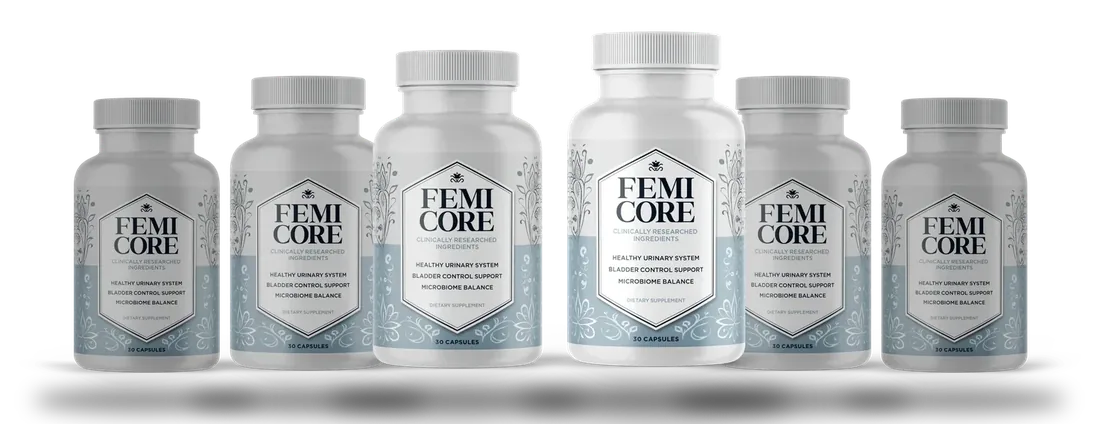
FemiCore comes in packs of two, three or six bottles, at $79, $69 or $49 a bottle. Each bottle lasts 30 days at one capsule a day.
Prices come from the sales page in October 2026, and the checkout price applies if it differs (FemiCore sales page).
How many bottles of FemiCore does a year take?
Twelve bottles, at one capsule a day. Two 6-bottle packs cover that, at $49 a bottle each time, with free shipping on both. Before buying a year ahead, remember that bearberry is a one-week herb in EU guidance (EMA, Uvae ursi folium (bearberry leaf)) and ask your doctor about long use.
Is the "2+1" FemiCore pack really three bottles?
Yes. The sales page lists the middle pack as "2+1 bottles", which means three bottles at $69 each, $207 in total. Shipping on it appears as $9.99 in one place and free in another, so check the checkout before paying.
Why does a bottle cost less in the 6-bottle pack?
The seller prices bottles lower in bigger packs: $79 each in two, $69 in three and $49 in six. That works out to $2.63, $2.30 or $1.63 a day. A lower price per bottle only helps if you will really use six.
Are the FemiCore bonus ebooks printed books?
No, they are digital ebooks added to the 6-bottle pack. The titles cover relationships, digestion and hip and leg mobility, so none is about bladder health. Their claims belong to their publisher and have not been checked by this site.
Does the FemiCore price include sales tax?
Our pages show the pack prices from the sales page, not tax. Any sales tax or international fee is worked out at the checkout from your address. The total shown on the final checkout screen is the amount charged.
Can I combine packs to cover an odd number of months?
Yes, by placing separate orders. Eight months, for example, could be a 6-bottle pack plus a 2-bottle pack. The FemiCore pricing page has a planner that finds the cheapest mix for the months you choose.
Group 7
Who helps after you order FemiCore?
After you order FemiCore, the order desk at +1 (302) 200-3480 handles tracking, changes and refunds. When you call, have your order ID ready.
The website inbox, [email protected], handles page errors and privacy but cannot see orders. The returns address and the office address are different, so check which one you need.
- Tracking and refunds: +1 (302) 200-3480
- Page errors and privacy: [email protected]
- Returns mail: 419 Park Avenue South, Floor 7, New York, NY 10016, USA, after calling first
Who do I call if my FemiCore parcel arrives damaged?
Call the order desk at +1 (302) 200-3480 with your order ID and photos ready. Do not take capsules from a bottle whose safety seal is damaged or missing; the label says not to use it. Keep the packaging until the desk replies.
Can I switch to a different pack after ordering?
Ask the order desk as soon as possible at +1 (302) 200-3480. Changes depend on whether the parcel has shipped, and only the desk can see that. The website inbox cannot change or cancel orders.
What goes inside a FemiCore return parcel?
Put a note with your full name, email and order ID inside, along with the bottles. Call the order desk first so it can confirm the address, then ship with tracking. The buyer pays return postage, so keep the receipt.
Why might my card statement show a different name than FemiCore?
The charge is processed by the checkout's payment processor, so your bank may show its name or a short code instead of FemiCore. If you do not recognize a charge, call the order desk with the date and amount before disputing it.
Is the FemiCore returns address the same as the office address?
No. Returns go to 419 Park Avenue South, Floor 7, New York, NY 10016, after you call the desk. The office at 26 Broadway, Suite 1108, handles letters about the website. Mailing bottles to the office can delay a refund.
How do I report a problem with the capsules themselves?
For a refund, call the order desk. For a health reaction, stop the capsules, see a clinician, and report it through the FDA safety portal (FDA, Report a Supplement Problem). For a label or quality question, use the brand email printed on the bottle.
Who wrote this
Written and reviewed by
Pages built from the label, the sales page and linked NIH, FDA, FTC, EMA and peer-reviewed sources.
Last updated . See our editorial standards and how we check reviews. This website is run by a U.S. stocking partner for FemiCore, not by the manufacturer or the label's distributor. We are paid when you buy through our order links.
Keep reading
More about FemiCore

U.S. stocking partner for FemiCore
Ready to try FemiCore?
Start with a check of your medicines, then pick a pack. Six bottles ship free and cost the least per bottle, and every pack sits inside the 60-day money-back window.
- Secure checkout
- 60-day money-back guarantee
- Ships from the U.S.