Blog · Menopause
Do Hormone Balance Supplements Work for Bladder Changes?
Do hormone balance supplements work? For the bladder, our cited sources give no support: none tests a supplement that claims to balance hormones against urinary symptoms. Low estrogen after menopause can affect the urinary tract, and medical options such as vaginal estrogen exist. FemiCore lists no hormone-active ingredient and makes no hormone claim.
Written by the FemiCore label benchUpdated · 5 min read
The claim
What do hormone balance supplements claim?
Hormone balance supplements claim to steady mood, sleep, hot flashes or weight around menopause. The phrase is a marketing term, not a measured result. Under federal rules a seller may say a product supports a body function, but may not claim it treats a disease (21 CFR 101.93, structure/function claims).
No supplement is approved by the FDA before sale (FDA, Information for Consumers on Supplements). Health claims need competent and reliable scientific evidence, usually randomized, controlled testing in people (FTC, Health Products Compliance Guidance).
A study of one ingredient says little about another, and a hot flash study says nothing about the bladder. Ask which outcome was measured, in whom, and for how long.
Our sources do not evaluate hormone balance supplements as a group, so we cannot say whether they work. We can say what is known about hormones and the bladder.
The link
How do hormones affect the bladder after menopause?
Lower estrogen thins and dries vaginal tissue, and Cleveland Clinic notes it can also affect the urinary tract and bladder. Leaks are a possible postmenopausal symptom (Cleveland Clinic, postmenopause).
Mayo explains that menopause raises the risk of urinary infection because lower estrogen changes vaginal bacteria (Mayo Clinic, UTI). The World Health Organization lists incontinence among menopause symptoms and says pelvic support structures can weaken (WHO, Menopause fact sheet).
So hormones matter, and the cause is real. The question is whether a capsule can fix it. For recurrent infections NICE says vaginal estrogen may be considered when other steps fail, and says systemic HRT should not be offered for that purpose (NICE NG112, recurrent UTI).
That is a prescribed treatment, decided with a clinician. It is not something a shelf product copies.
Cleveland Clinic lists lubricants, vaginal creams, laser therapy and hormone therapy as options for the genitourinary changes of menopause (Cleveland Clinic, postmenopause).
| Approach | Evidence in our sources |
|---|---|
| Pelvic floor training | First-line for stress or mixed leaks (NICE NG123, incontinence in women) |
| Bladder training | First-line for urgency (NICE NG123, incontinence in women) |
| Vaginal estrogen | May be considered for recurrent infections (NICE NG112, recurrent UTI) |
| Hormone balance supplement | None found |
FemiCore
Is FemiCore a hormone balance supplement?
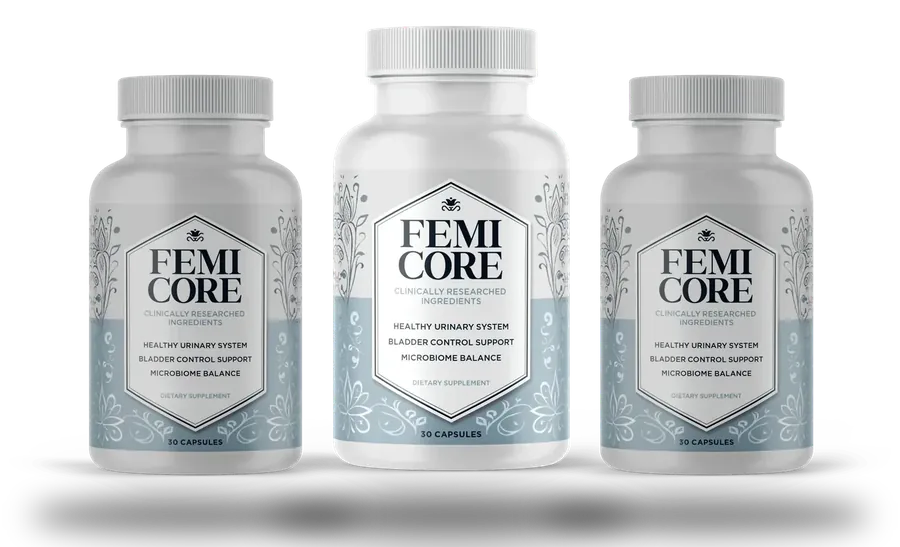
No. FemiCore lists a 350 mg herbal blend and a 50 mg probiotic blend, with no ingredient the label describes as hormonal. The front claims are "Healthy Urinary System", "Bladder Control Support" and "Microbiome Balance".
The ceilings below show how the weights are shared. They are maximums set by label order, not amounts.
Herbal Blend · 4 lines
- Mimosa pudicaMimosa pudica Seed Extract≤ 350 mg
- CranberryCranberry Extract (Vaccinium macrocarpon)(berry)(std. to 30% proanthocyanidin)≤ 175 mg
- BearberryBearberry (Arctostaphylos uva-ursi)(leaf)≤ 116.7 mg
- BerberineGranular Berberine Hydrochloride Extract 8% (bark/root)≤ 87.5 mg
Probiotic Blend · 5 lines
- L. crispatus LCr86strain 1 of 5≤ 50 mg
- L. acidophilus LA88strain 2 of 5≤ 25 mg
- L. plantarum N13strain 3 of 5≤ 16.7 mg
- L. gasseri LG08strain 4 of 5≤ 12.5 mg
- L. casei LC16strain 5 of 5≤ 10 mg
RuleA proprietary blend lists its lines from most to least by weight and prints only the total (21 CFR 101.36, supplement labeling).
SoLine 2 cannot outweigh line 1, so it holds at most half the blend; line 3 at most a third; line k at most total/k.
LimitsCeilings, not amounts: a lower line can be tiny. Probiotic weight is not a CFU count, and the label prints no CFU.
Each circle's area is drawn to scale with its ceiling. Our arithmetic from the label, not a lab test.
Berberine is a plant compound. Our sources describe it only for liver safety, with no liver signal and mild stomach effects (NIH LiverTox, Berberine). Nothing cited links any line to hormones.
Calling the capsule hormone-friendly would go past the label, so we do not.
The honest reading is narrower. Menopause is one cause of bladder change among several, and the capsule's own claims are about the urinary system and the microbiome, not about estrogen.
FemiCore: from $49 a bottle30 capsules · 2, 3 or 6 bottles · free shipping on 6 · 60-day money-back guarantee
See packsWhat helps
What should you do about bladder changes in perimenopause or menopause?
Start with a diary and first-line care. Keep a record for three days, begin pelvic floor sets, and trial less caffeine (NICE NG123, incontinence in women).
Book a visit if you have leaks, burning, repeated infections or any bleeding after menopause (Cleveland Clinic, postmenopause). Ask whether vaginal estrogen, bladder training or a referral fits you.
Cleveland Clinic says bladder training usually takes at least six to eight weeks to show results (Cleveland Clinic, overactive bladder), so give each step time and keep the diary going.
Keep taking prescribed medicine as directed, including any hormone therapy. Tell your pharmacist about every supplement, because they can interact with medicines (NCCIH, Using Supplements Wisely).
Decide
Should you try a supplement while you wait for care?
It is your choice, and it should follow, not replace, the steps above. Read our menopause and bladder guide first.
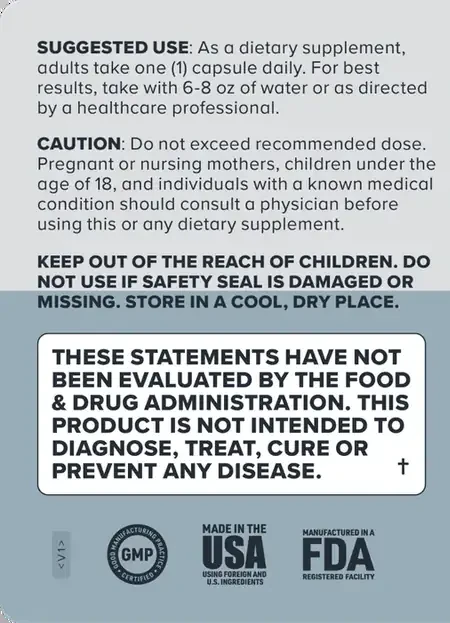
If you try FemiCore, the label directs one capsule daily with 6-8 oz of water, and the sales page shows $79 a bottle on two, $69 on three and $49 on six.
U.S. stocking partner for FemiCore
Ready to try FemiCore?
Start with a check of your medicines, then pick a pack. Six bottles ship free and cost the least per bottle, and every pack sits inside the 60-day money-back window.
- Secure checkout
- 60-day money-back guarantee
- Ships from the U.S.
FAQ
Hormone balance questions, answered
Can a supplement replace hormone therapy for bladder symptoms?
No source we cite says so. Hormone therapy is prescribed by a clinician, and the choice depends on your history. Do not stop or change a prescription for a capsule.
Do hormone balance supplements cause side effects?
Side effects depend on the ingredients, and many are not studied in our sources. Stomach upset is common with herbs. Report serious reactions, including blood in urine, and ask a pharmacist about interactions.
How can I tell if bladder changes are from hormones?
You cannot tell on your own. Menopause is one cause among several, so a clinician looks at infection, medicines and pelvic support too.
Who wrote this
Written and reviewed by
Pages built from the label, the sales page and linked NIH, FDA, FTC, EMA and peer-reviewed sources.
Last updated . See our editorial standards and how we check reviews. This website is run by a U.S. stocking partner for FemiCore, not by the manufacturer or the label's distributor. We are paid when you buy through our order links.
Keep reading
More about FemiCore


U.S. stocking partner for FemiCore
Ready to try FemiCore?
Start with a check of your medicines, then pick a pack. Six bottles ship free and cost the least per bottle, and every pack sits inside the 60-day money-back window.
- Secure checkout
- 60-day money-back guarantee
- Ships from the U.S.