Blog · Ingredients
The FemiCore Ingredients List: All Nine Lines in Label Order
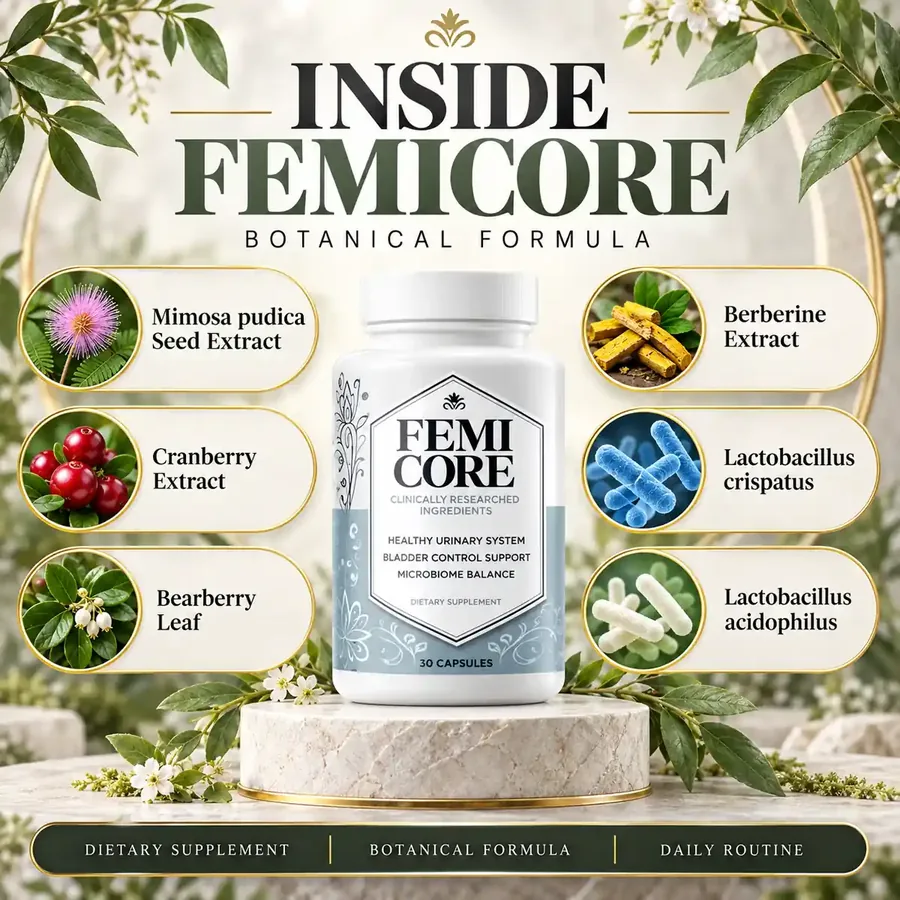
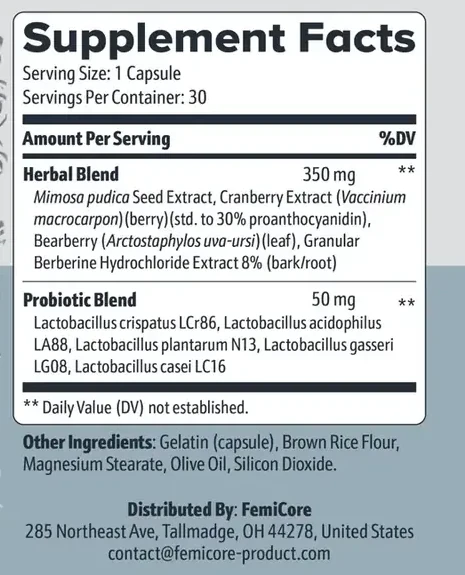
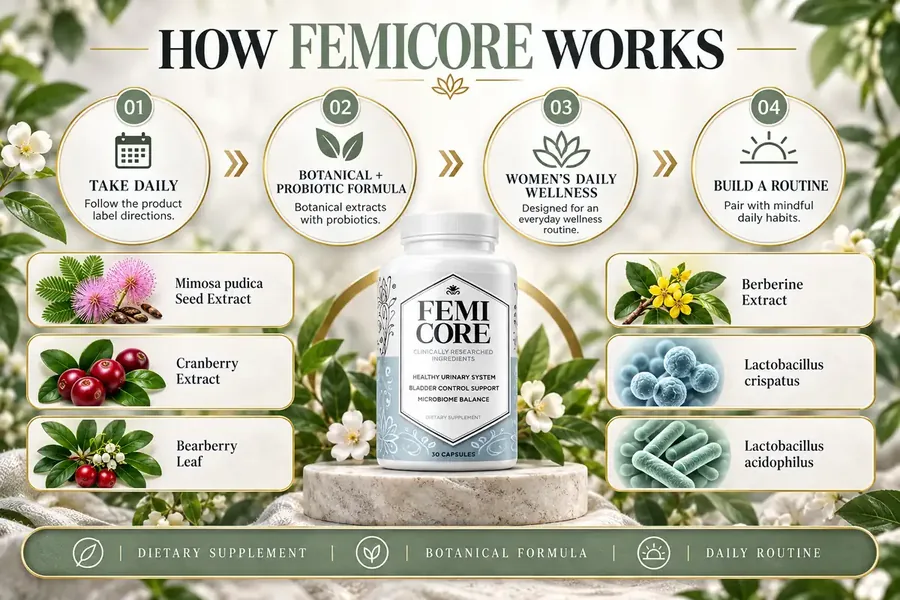
The FemiCore ingredients list has nine named lines in two blends. The 350 mg herbal blend holds Mimosa pudica seed extract, cranberry extract standardized to 30% proanthocyanidin, bearberry leaf and berberine hydrochloride extract 8%. The 50 mg probiotic blend holds five Lactobacillus strains: crispatus LCr86, acidophilus LA88, plantarum N13, gasseri LG08 and casei LC16. The label prints no single amount, and the capsule shell is gelatin.
Written by the FemiCore label benchUpdated · 5 min read
The list
What is on the FemiCore ingredients list?
The FemiCore ingredients list has two blends. The herbal blend of 350 mg holds Mimosa pudica seed extract, cranberry extract standardized to 30% proanthocyanidin, bearberry leaf and berberine hydrochloride extract 8%.
The probiotic blend of 50 mg holds Lactobacillus crispatus LCr86, L. acidophilus LA88, L. plantarum N13, L. gasseri LG08 and L. casei LC16. The shell and fillers are gelatin, brown rice flour, magnesium stearate, olive oil and silicon dioxide.
Read the shell line too. Gelatin is animal-derived, so the capsule is not vegetarian or vegan. Brown rice flour, olive oil, magnesium stearate and silicon dioxide are the fillers and flow aids.
The seller's brief lists only six ingredients. The bottle lists nine, and when the two disagree the bottle wins.
Label order
Why does the order of the FemiCore ingredients matter?
Order matters because a blend lists its lines from most to least by weight, and the maker prints only the total (21 CFR 101.36, supplement labeling). Line k can weigh at most the total divided by k.
So Mimosa pudica could be the whole 350 mg or a small share of it. Cranberry, second, is capped at 175 mg. Bearberry is capped near 117 mg and berberine extract at 87.5 mg.
The same logic runs through the probiotic blend. L. crispatus is first and could be most of the 50 mg, while L. casei, last of five, is capped at 10 mg. A cap is not a guess about what is actually inside.
The bars below draw each ceiling against its blend. A long bar is a limit, not a measurement.
Research
What does research say about each FemiCore ingredient?
Each herb has a different record, and none was tested inside FemiCore. Cranberry has the strongest file: a Cochrane review of 50 trials found fewer symptomatic urinary infections with cranberry products, with a risk ratio of 0.70 (Cochrane 2023, cranberries and UTI). That concerns infections, not bladder control.
Bearberry is a short-term herb. The EU monograph limits use to one week and bars women with kidney disorders (EMA, Uvae ursi folium (bearberry leaf)). For berberine, the liver database found no injury signal (NIH LiverTox, Berberine). For Mimosa pudica seed we found no human trial or public fact sheet.
| Line | Ceiling | What we found |
|---|---|---|
| Mimosa pudica seed | 350 mg | No human trial or fact sheet |
| Cranberry | 175 mg | Reviewed for repeat UTIs, not leaks |
| Bearberry leaf | about 117 mg | One-week traditional use in EU guidance |
| Berberine extract | 87.5 mg | Liver safety record; no bladder data |
FemiCore: from $49 a bottle30 capsules · 2, 3 or 6 bottles · free shipping on 6 · 60-day money-back guarantee
See packsProbiotic strains
Which probiotic strains are on the FemiCore ingredients list?
Five strains are named by genus, species and a strain code. The code matters, because probiotic effects belong to a strain, not to a whole species (NCCIH, Probiotics).
That is a thin file for a product that leads with "Clinically Researched Ingredients". The phrase describes the ingredient names, not the capsule, and it does not say which ingredients or at what dose.
Only one has a completed trial we could find. L. crispatus LCr86 was tested in 80 women taking 10 billion CFU a day, measured by a vaginal score, and no results are posted (ClinicalTrials.gov NCT06830122, LCr86). No published trial turned up for the other four. FemiCore prints no CFU count, so its dose cannot be matched to that trial.
The full ingredients page gives each line its own profile.
Before you buy
Is the FemiCore ingredients list enough to judge it?
Reading a list is still useful. It tells you whether you have a known sensitivity to an herb, whether gelatin is a problem for you and which lines a clinician should look up.
It is enough to know what is named, not what is dosed. The names are open and the amounts are closed. Bring the list to a pharmacist, along with every medicine you take.
Supplements can interact with prescribed drugs, and no source we read covers berberine or bearberry interactions, so that question belongs to a professional (NCCIH, Using Supplements Wisely).
Prices seen in October 2026 are $79 a bottle for two, $69 for three and $49 for six.
U.S. stocking partner for FemiCore
Ready to try FemiCore?
Start with a check of your medicines, then pick a pack. Six bottles ship free and cost the least per bottle, and every pack sits inside the 60-day money-back window.
- Secure checkout
- 60-day money-back guarantee
- Ships from the U.S.
FAQ
FemiCore ingredients list questions, answered
How many ingredients are in FemiCore?
The label names nine: four in the herbal blend and five probiotic strains. The seller's brief and one graphic show only six, so count from the bottle, not the graphic.
Does FemiCore contain anything artificial?
The other ingredients are gelatin, brown rice flour, magnesium stearate, olive oil and silicon dioxide. The label does not call anything artificial or natural, so a stated certification would be needed.
Is FemiCore free of common allergens?
The label does not print an allergen statement we could read. Gelatin is animal-derived. If you have a food allergy, ask the distributor for written confirmation before use.
Who wrote this
Written and reviewed by
Pages built from the label, the sales page and linked NIH, FDA, FTC, EMA and peer-reviewed sources.
Last updated . See our editorial standards and how we check reviews. This website is run by a U.S. stocking partner for FemiCore, not by the manufacturer or the label's distributor. We are paid when you buy through our order links.
Keep reading
More about FemiCore
U.S. stocking partner for FemiCore
Ready to try FemiCore?
Start with a check of your medicines, then pick a pack. Six bottles ship free and cost the least per bottle, and every pack sits inside the 60-day money-back window.
- Secure checkout
- 60-day money-back guarantee
- Ships from the U.S.