Blog · Overactive bladder
Overactive Bladder in Women: Signs and First Steps
Overactive bladder in women is a pattern of sudden urges, often with 8 or more trips in 24 hours or waking more than twice a night. The AUA 2024 guideline offers behavioral therapy and bladder training first. FemiCore claims "Bladder Control Support", yet no trial of the capsule is named.
Written by the FemiCore label benchUpdated · 5 min read

Definition
What is overactive bladder in women?
Overactive bladder in women is a cluster of symptoms: a sudden urge that is hard to delay, frequent trips, and sometimes leaks. Mayo Clinic counts 8 or more trips in 24 hours, or waking more than twice a night, as typical (Mayo Clinic, overactive bladder).
Doctors ask about urgency first, then about trips by day and by night. A short diary answers both questions better than memory can.
It is a pattern and not a single disease. Several causes can sit behind it, so a clinician checks for infection, emptying problems and other triggers.
Not everyone with urgency leaks. Urge incontinence is the leaking version, and overactive bladder can occur without it.
Menopause can add to the picture, because the genitourinary syndrome of menopause can affect the bladder (Cleveland Clinic, postmenopause).
First-line care
What is the first treatment for overactive bladder?
The first treatment is behavioral. The AUA 2024 guideline says to offer behavioral therapy and bladder training to all patients, a strong recommendation at Grade A (AUA/SUFU 2024, OAB guideline).
NICE agrees: bladder training for at least 6 weeks for urgency, and a trial of less caffeine (NICE NG123, incontinence in women). Cleveland Clinic gives bladder training 6 to 8 weeks (Cleveland Clinic, overactive bladder).
- Keep a diary of drinks, trips and leaks.
- Delay each urge, starting with about 10 minutes.
- Cut back caffeine and alcohol, as the AUA suggests.
- Practice pelvic floor sets.
Our pelvic floor training guide shows how.
| Sign | Threshold in Mayo Clinic |
|---|---|
| Trips in 24 hours | 8 or more |
| Night wake-ups to urinate | More than 2 |
| Urge that is hard to delay | Sudden and strong |
Counting your own trips for 3 days gives you the same numbers. Use a plain list, and bring it to the visit.
Capsules
Can FemiCore help overactive bladder?
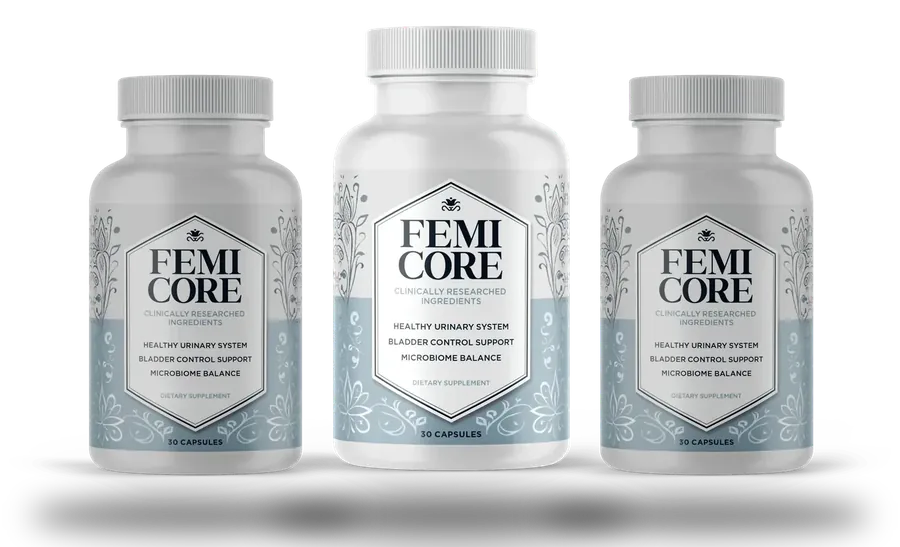
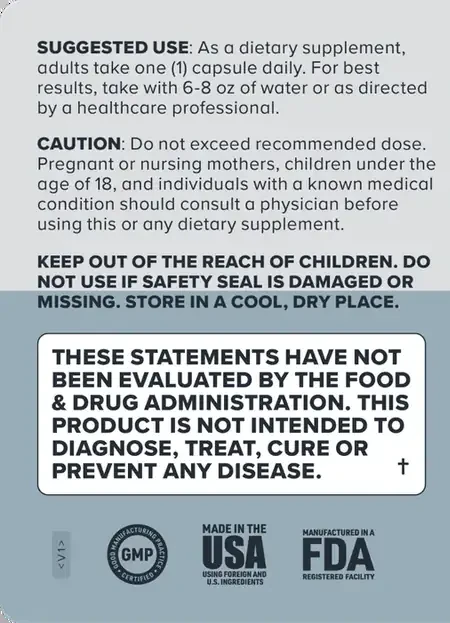
No trial shows that it does. The label says "Bladder Control Support", a structure and function claim, which is not a disease claim and is not reviewed by the FDA (21 CFR 101.93, structure/function claims).
Compare what the label suggests with what the sources show.
- Label front“Healthy Urinary System†”Structure/function wording, allowed with the FDA statement. Not a disease claim, and FDA did not review it. (21 CFR 101.93, structure/function claims)
- Label front“Bladder Control Support†”No trial of FemiCore was found. None of the nine lines has a bladder-control trial; the first-line care for leaks is pelvic floor and bladder training. (NICE NG123, incontinence in women) (Cochrane, PFMT for incontinence)
- Label front“Microbiome Balance†”Effects are strain-specific, and no CFU count is printed. The one strain with a registered trial (LCr86) was tested at a stated dose for a vaginal outcome. (ClinicalTrials.gov NCT06830122, LCr86)
- Label front“Clinically Researched Ingredients”Some ingredients have research for other uses (cranberry and repeat UTIs, berberine and blood sugar). That is not research on this capsule. (Cochrane 2023, cranberries and UTI) (NCCIH, Cranberry)
- Sales page“scientifically proven”No study is named on the sales text we reviewed. A claim like this needs competent and reliable evidence. (FTC, Health Products Compliance Guidance)
- Sales page“The Natural Breakthrough Formula That Supports a Strong Bladder”Marketing language. Bearberry is a one-week herb in EU guidance, not a daily, long-term one. (EMA, Uvae ursi folium (bearberry leaf))
- Sales page60-day money-back badgesThe images show 60 days; the written terms are not printed on the sales text. We count from the date of purchase. (FemiCore sales page)
Claims as printed on the label and the sales page (FemiCore sales page). Health claims need competent and reliable scientific evidence (FTC, Health Products Compliance Guidance).
Cranberry has evidence for fewer repeat urinary infections in some groups (Cochrane 2023, cranberries and UTI), which is not overactive bladder. The other lines have no cited evidence for it. Strain effects are specific, and the one trial we found of LCr86 measured vaginal outcomes, not the bladder (ClinicalTrials.gov NCT06830122, LCr86).

FemiCore: from $49 a bottle30 capsules · 2, 3 or 6 bottles · free shipping on 6 · 60-day money-back guarantee
See packsMedicines
What medicines treat overactive bladder in women?
Prescription medicines are an option after behavioral steps. The AUA guideline discusses them, and it asks clinicians to talk about dementia risk with antimuscarinics (AUA/SUFU 2024, OAB guideline).
A BMJ study and Harvard Health summary describe an association between anticholinergic bladder drugs and dementia. They advise people to keep taking them until they talk to their doctor (Harvard Health, anticholinergics and dementia).
Never stop or change a prescription because of a supplement or an article. Ask the prescriber first.
Behavioral steps carry no side effects of that kind, which is one reason guidelines offer them first. Medicines are added when the steps alone do not give enough relief.
A supplement that claims bladder support is not a replacement for any of these steps.
Care
When should you see a clinician about overactive bladder?
Bring your diary and your medicine list. Say how long the urgency has lasted, how it affects sleep and whether it limits trips out of the house. Those details guide the plan more than the label of the condition does.
See one if urgency is frequent or disrupts sleep. NIDDK advises seeing a professional right away for frequent urges or leaks (NIDDK, bladder control problems in women).
Get same-day care for fever, flank pain or burning, which suggest infection (CDC, About UTIs). Blood in the urine always needs a check (MedlinePlus, Blood in urine).
If you wish to add a capsule beside the behavioral steps, the sales page shows $79 a bottle on two, $69 on three and $49 on six, with a 60-day guarantee badge. Read the is FemiCore legit page first.
U.S. stocking partner for FemiCore
Ready to try FemiCore?
Start with a check of your medicines, then pick a pack. Six bottles ship free and cost the least per bottle, and every pack sits inside the 60-day money-back window.
- Secure checkout
- 60-day money-back guarantee
- Ships from the U.S.
FAQ
Overactive bladder questions, answered
How many times a day is too often to urinate?
Mayo Clinic counts 8 or more trips in 24 hours as a sign of overactive bladder. Check your count with a 3-day diary.
Does caffeine make overactive bladder worse?
NICE and the AUA both advise a trial of less caffeine. Reduce it slowly and see whether your diary changes.
Can overactive bladder go away on its own?
Our sources do not say. They show that behavioral steps can help, so seeing a clinician is wiser than waiting.
Is overactive bladder a normal part of aging?
Mayo Clinic says incontinence is not an inevitable part of aging. Ask for an assessment instead of accepting it.
Who wrote this
Written and reviewed by
Pages built from the label, the sales page and linked NIH, FDA, FTC, EMA and peer-reviewed sources.
Last updated . See our editorial standards and how we check reviews. This website is run by a U.S. stocking partner for FemiCore, not by the manufacturer or the label's distributor. We are paid when you buy through our order links.
Keep reading
More about FemiCore


U.S. stocking partner for FemiCore
Ready to try FemiCore?
Start with a check of your medicines, then pick a pack. Six bottles ship free and cost the least per bottle, and every pack sits inside the 60-day money-back window.
- Secure checkout
- 60-day money-back guarantee
- Ships from the U.S.