Blog · Probiotics
CFU vs mg: Two Numbers That Measure Different Things
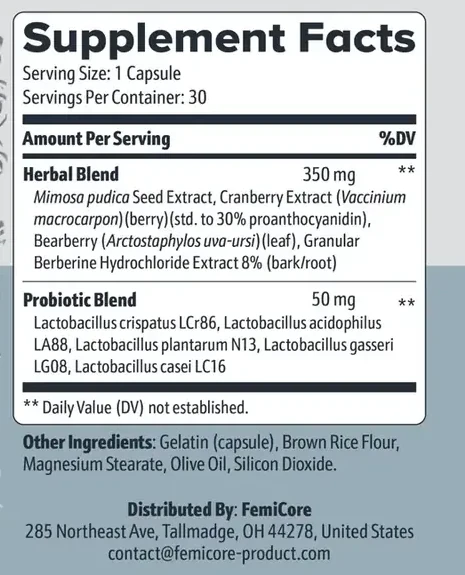
CFU vs mg is a comparison of two different measures. Milligrams weigh everything in the blend, including dead cells and carriers. CFU counts only live cells that can grow. You cannot convert one into the other. FemiCore prints a 50 mg probiotic blend and no CFU figure, so its live count is unknown.
Written by the FemiCore label benchUpdated · 4 min read

The difference
What is the difference between CFU and mg on a probiotic?
Milligrams measure mass and CFU measures life. A milligram figure says how much a blend weighs on a scale. A CFU figure says how many cells in that blend were alive and able to grow.
Think of a cup of dry yeast. Two cups can weigh the same, yet one has been stored in a hot cupboard for a year and will not rise. The scale cannot tell them apart. A rising test can.
A probiotic works the same way. The powder holds live cells, dead cells, the leftover growth medium and any carrier. NIH points out that label weight includes dead cells, and that is why it suggests looking for a CFU count at the end of shelf life (NIH ODS, Probiotics).
No formula
Can you convert probiotic mg to CFU?
No, you cannot convert probiotic milligrams to CFU. The ratio depends on the strain, the carrier, how the batch was dried and how long it has sat on a shelf.
A web calculator that turns 50 mg into a number of billions is guessing. Real CFU comes from a lab count on the product.
| Question | Milligrams | CFU |
|---|---|---|
| What it measures | Mass of the blend | Live, growing cells |
| Counts dead cells | Yes | No |
| Needs a lab test | No, a scale is enough | Yes |
| Printed by FemiCore | 50 mg, total only | Not printed |
The 50 mg blend
What does the 50 mg on the FemiCore label tell you?
The 50 mg tells you the total weight of the Probiotic Blend and nothing about live cells. It is shared by five strains, and the label prints no single amounts.
Blend rules list the strains from most to least by weight (21 CFR 101.36, supplement labeling). Line k weighs at most 50 divided by k. That gives ceilings of 50, 25, about 17, 12.5 and 10 mg for the five lines. A lower line can be far smaller.
Even the ceiling for the whole blend, 50 mg, may include carrier and dead cells. So the true live dose is unknown, and the sums below only show the weight limits.
Herbal Blend · 4 lines
- Mimosa pudicaMimosa pudica Seed Extract≤ 350 mg
- CranberryCranberry Extract (Vaccinium macrocarpon)(berry)(std. to 30% proanthocyanidin)≤ 175 mg
- BearberryBearberry (Arctostaphylos uva-ursi)(leaf)≤ 116.7 mg
- BerberineGranular Berberine Hydrochloride Extract 8% (bark/root)≤ 87.5 mg
Probiotic Blend · 5 lines
- L. crispatus LCr86strain 1 of 5≤ 50 mg
- L. acidophilus LA88strain 2 of 5≤ 25 mg
- L. plantarum N13strain 3 of 5≤ 16.7 mg
- L. gasseri LG08strain 4 of 5≤ 12.5 mg
- L. casei LC16strain 5 of 5≤ 10 mg
RuleA proprietary blend lists its lines from most to least by weight and prints only the total (21 CFR 101.36, supplement labeling).
SoLine 2 cannot outweigh line 1, so it holds at most half the blend; line 3 at most a third; line k at most total/k.
LimitsCeilings, not amounts: a lower line can be tiny. Probiotic weight is not a CFU count, and the label prints no CFU.
Each circle's area is drawn to scale with its ceiling. Our arithmetic from the label, not a lab test.

FemiCore: from $49 a bottle30 capsules · 2, 3 or 6 bottles · free shipping on 6 · 60-day money-back guarantee
See packsComparing
How do you compare two probiotics fairly?
Compare them on strain, CFU at end of shelf life and storage, in that order. Weight comes last because it hides the live fraction.
First, check that each strain is named to the strain level, with its letters and numbers, not only a species. Second, look for a CFU count tied to the expiry date. Third, check whether the bottle needs the fridge and whether yours has been kept as directed.
A product that fails the first two checks cannot be compared on dose at all. That is the position of a label with a blend weight and no count, and it applies to any brand, not only this one.
The evidence
Do any trials give a dose in CFU for these strains?
For one strain only, and without results. A completed industry trial of LCr86 gave 80 women 10 billion CFU a day by mouth against a placebo for 8 weeks, but no results were posted (ClinicalTrials.gov NCT06830122, LCr86).
No published trial was found for LA88, N13, LG08 or LC16. Probiotic effects are strain-specific, so a result for one strain says little about another (NCCIH, Probiotics).
The FemiCore label cannot be matched to the trial dose, because it prints a weight and not a count. Read the Supplement Facts page for the full panel.
If you are pregnant, nursing, under 18 or live with a medical condition, the label says to see a physician before use.
U.S. stocking partner for FemiCore
Ready to try FemiCore?
Start with a check of your medicines, then pick a pack. Six bottles ship free and cost the least per bottle, and every pack sits inside the 60-day money-back window.
- Secure checkout
- 60-day money-back guarantee
- Ships from the U.S.

FAQ
CFU and milligram questions, answered
Is 50 mg of probiotic a lot or a little?
It cannot be judged from weight alone. Fifty milligrams could hold many live cells or few, depending on strain and processing. Only a CFU figure shows the live dose.
Why do some labels show both mg and CFU?
Because they answer different questions. The milligram line shows the amount of blend, while the CFU line shows how much of it was alive. A label with both is easier to compare.
Does a bigger milligram number mean more bacteria?
Not reliably. More powder can mean more carrier or more dead cells. Compare CFU counts at end of shelf life, not weights, when you compare two products.
Does a probiotic need a CFU count to be safe?
Safety and dose are separate questions. Probiotics are generally low-risk in healthy people, but risk is higher with severe illness or weak immunity, so ask a clinician first (NIH ODS, Probiotics).
Who can measure CFU for me?
A lab does, on a sample of the lot. You can ask the seller for that report. If none exists, the count is unconfirmed, which is the case for FemiCore.
Who wrote this
Written and reviewed by
Pages built from the label, the sales page and linked NIH, FDA, FTC, EMA and peer-reviewed sources.
Last updated . See our editorial standards and how we check reviews. This website is run by a U.S. stocking partner for FemiCore, not by the manufacturer or the label's distributor. We are paid when you buy through our order links.
Keep reading
More about FemiCore


U.S. stocking partner for FemiCore
Ready to try FemiCore?
Start with a check of your medicines, then pick a pack. Six bottles ship free and cost the least per bottle, and every pack sits inside the 60-day money-back window.
- Secure checkout
- 60-day money-back guarantee
- Ships from the U.S.