Blog · Cranberry
What Is PAC in Cranberry, and Why Do Labels List It?
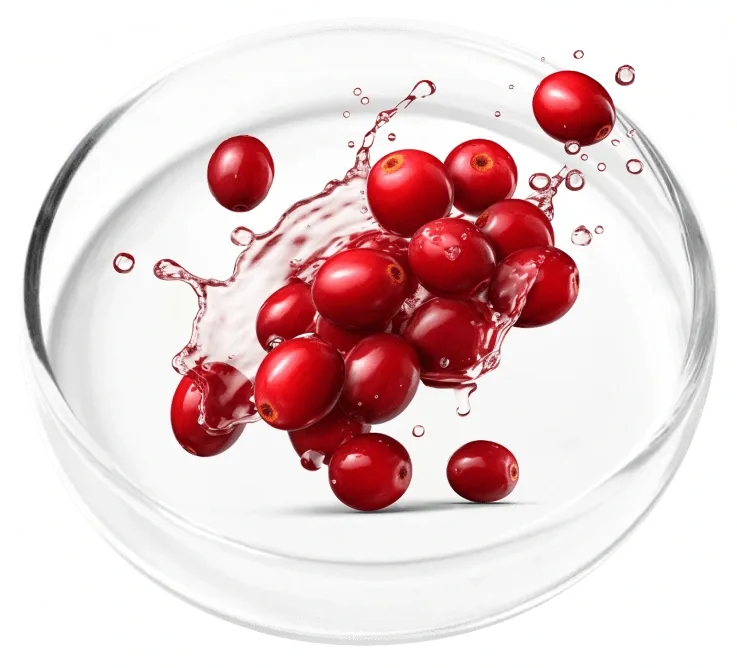
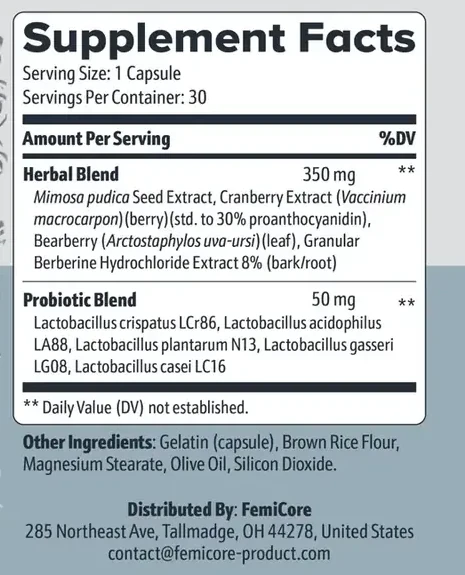
What is PAC in cranberry? PAC means proanthocyanidins, a family of plant compounds that supplement makers use to standardize cranberry extracts. FemiCore's cranberry is standardized to 30% PAC inside a 350 mg blend, which caps the PAC at about 52 mg by the maker's own, unnamed test method.
Written by the FemiCore label benchUpdated · 4 min read
The term
What does PAC mean on a cranberry label?
PAC on a cranberry label means proanthocyanidins, a group of plant compounds found in the fruit. Makers use the figure to say how concentrated an extract is, as a percentage of the extract by weight.
Take the phrase "std. to 30% proanthocyanidin." It tells you that the maker tested the extract and found PAC at about 30% of its weight. It does not tell you how much extract is in one capsule.
The number is only as useful as the test behind it. Labs use several methods for PAC, and each can give a different result for the same powder.
Methods
Why can PAC numbers from different labels not be compared?
PAC numbers from different methods do not compare, because each method measures the compounds in its own way. A figure from one lab can read higher or lower than another lab's figure for the same extract.
So a study dose of PAC and a product label can only be matched if both name the same method. The FemiCore label names none, and the bottle does not say how its 30% was found.
That is why we never say a capsule "matches" a trial. A match needs the same extract, the same method and the same dose, and a supplement label rarely prints all three.
Same extract, same test method, same dose. If one is missing, call the match unproven.
The sums
How much PAC can one FemiCore capsule hold?
One FemiCore capsule holds at most about 52 mg of PAC. The cranberry extract is line 2 in a 350 mg blend, and label order caps line k at 350 divided by k (21 CFR 101.36, supplement labeling).
That gives a ceiling of 175 mg for the extract. Thirty percent of 175 mg is 52.5 mg, so about 52 mg is the most PAC the capsule could carry by the maker's method.
It is a ceiling, not an amount. The extract could weigh far less, and then the PAC would be lower. The label prints no single weight to settle it.
| Step | Working | Result |
|---|---|---|
| Blend total | Printed on label | 350 mg |
| Cranberry ceiling | 350 / 2 | At most 175 mg |
| PAC at 30% | 175 x 0.30 | At most about 52 mg |
| Actual amount | Not printed | Unknown |
| Label line | Place | Per capsule | Amount used in research | Evidence |
|---|---|---|---|---|
| Mimosa pudica Seed Extract | Herbal 1/4 | at most 350 mg | No human dose found in public health sources (NCCIH, Using Supplements Wisely) | No human trial found; no bladder trial |
| Cranberry Extract (Vaccinium macrocarpon)(berry)(std. to 30% proanthocyanidin) | Herbal 2/4 | at most 175 mg | Trials tested many cranberry products and doses (50 trials, Cochrane 2023) (Cochrane 2023, cranberries and UTI) (NCCIH, Cranberry) | Moderate: fewer repeat UTIs in some groups; no bladder-control data |
| Bearberry (Arctostaphylos uva-ursi)(leaf) | Herbal 3/4 | at most 116.7 mg | EU traditional use: adult women, no longer than one week (EMA, Uvae ursi folium (bearberry leaf)) (NIH LiverTox, Uva Ursi) | Traditional use only; no clinical studies of bearberry leaf alone |
| Granular Berberine Hydrochloride Extract 8% (bark/root) | Herbal 4/4 | at most 87.5 mg | No urinary or bladder dose has been studied (NIH LiverTox, Berberine) | No bladder or urinary trial found |
| Lactobacillus crispatus LCr86 | Strain 1/5 | at most 50 mg | One registered trial gave 10 billion CFU a day orally (vaginal outcome) (ClinicalTrials.gov NCT06830122, LCr86) (Ravel et al. 2011, vaginal microbiome) (NCCIH, Probiotics) | Strain trial completed; no results posted |
| Lactobacillus acidophilus LA88 | Strain 2/5 | at most 25 mg | No published trial found for this strain code (NCCIH, Probiotics) (NIH ODS, Probiotics) | Strain-specific evidence not found |
| Lactobacillus plantarum N13 | Strain 3/5 | at most 16.7 mg | No published trial found for this strain code (NCCIH, Probiotics) (NIH ODS, Probiotics) | Strain-specific evidence not found |
| Lactobacillus gasseri LG08 | Strain 4/5 | at most 12.5 mg | No published trial found for this strain code (NCCIH, Probiotics) (NIH ODS, Probiotics) | Strain-specific evidence not found |
| Lactobacillus casei LC16 | Strain 5/5 | at most 10 mg | No published trial found for this strain code (NCCIH, Probiotics) (NIH ODS, Probiotics) | Strain-specific evidence not found |
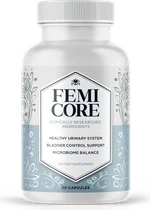
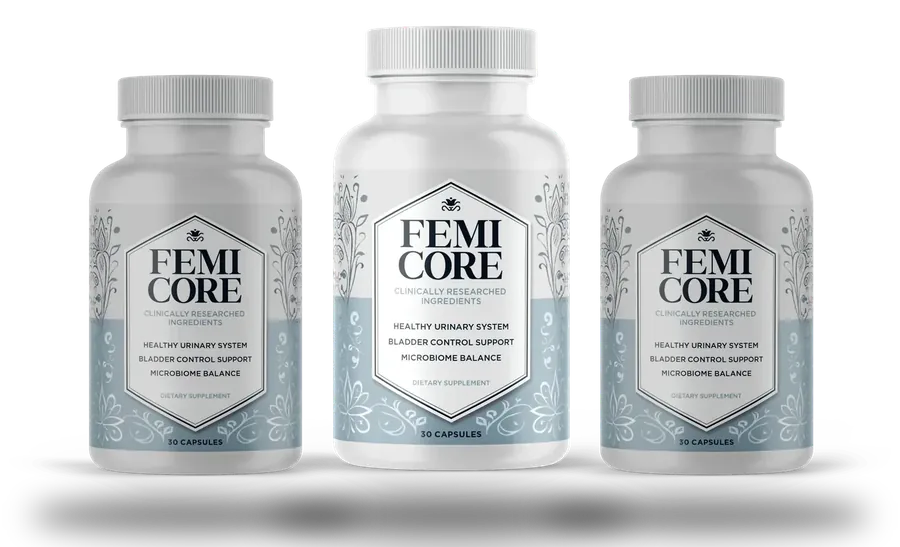
FemiCore: from $49 a bottle30 capsules · 2, 3 or 6 bottles · free shipping on 6 · 60-day money-back guarantee
See packsThe research
Does PAC in cranberry help urinary health?
Cranberry products have some evidence in specific groups, but PAC alone is not the proven part. A Cochrane review of 50 trials with 8,857 people found fewer symptomatic, culture-verified UTIs overall (RR 0.70), and in women with recurrent UTIs (RR 0.74) (Cochrane 2023, cranberries and UTI).
The same review found little or no benefit in elderly institutionalised adults, pregnant women, or people with incomplete bladder emptying. It studied cranberry products, not a multi-ingredient capsule (Cochrane 2023, cranberries and UTI).
NCCIH puts the lower repeat-UTI risk at about 25% in women, calls the findings inconsistent and says cranberry is not a treatment for an existing infection (NCCIH, Cranberry). Burning, urgency or fever need a clinician, not a capsule.
Deciding
What should you ask before relying on a PAC claim?
Ask which test method produced the percentage, and what weight of extract is in a capsule. Those two answers turn a vague 30% into something you can weigh.
If you take warfarin, speak to a provider, because evidence on cranberry and warfarin is conflicting (NCCIH, Cranberry). See the cranberry and UTIs guide for more.
The sales page lists $79 a bottle on two, $69 on three and $49 on six.
U.S. stocking partner for FemiCore
Ready to try FemiCore?
Start with a check of your medicines, then pick a pack. Six bottles ship free and cost the least per bottle, and every pack sits inside the 60-day money-back window.
- Secure checkout
- 60-day money-back guarantee
- Ships from the U.S.
FAQ
PAC questions, answered
Is a higher PAC percentage always better?
Not automatically. A percentage shows concentration, not dose, and methods differ. A 50 percent extract at a tiny weight could hold less PAC than a 30 percent extract at a larger one.
Is PAC the same as cranberry juice sugar?
No. PAC is a plant compound family. Sugar is a separate part of juice. Extracts are often standardized on PAC so that capsules do not rely on juice.
Who sets the test method for PAC?
The maker or its lab picks it. Different methods exist, so the method should be named beside the percentage. A label that omits it leaves the number hard to compare.
Does FemiCore say how it tested PAC?
No. The label prints the 30% standard but names no method and no lab. Without that, the PAC figure cannot be compared with any study dose.
Who wrote this
Written and reviewed by
Pages built from the label, the sales page and linked NIH, FDA, FTC, EMA and peer-reviewed sources.
Last updated . See our editorial standards and how we check reviews. This website is run by a U.S. stocking partner for FemiCore, not by the manufacturer or the label's distributor. We are paid when you buy through our order links.
Keep reading
More about FemiCore
U.S. stocking partner for FemiCore
Ready to try FemiCore?
Start with a check of your medicines, then pick a pack. Six bottles ship free and cost the least per bottle, and every pack sits inside the 60-day money-back window.
- Secure checkout
- 60-day money-back guarantee
- Ships from the U.S.